Many scrolled past, but you wanted to get to the bottom of this story. Let's continue.
Some gifts are meant to protect the people we love, but life has a cruel way of testing whether we truly understood what we were giving. I learned that lesson at 2:47 in the afternoon, standing on the threshold of a house I had paid for with eleven years of my life, watching my mother's hands turn raw against stone that was never supposed to be hers to clean.
The Dubai sun had been unforgiving that final week, the kind of heat that makes you question every choice that led you to the desert. I had been there for three years, two months, and eleven days, counting each one like a prisoner marks the walls of his cell.
My name is Alejandro, though everyone in the family calls me Alex. I am forty-two years old, the eldest of three siblings, and the only one who ever left our small town in the province of Alicante with the intention of never coming back poor.
When I boarded that Emirates flight on a Tuesday morning, one month before my scheduled return, I told no one. Not my wife, not my sister, and especially not my mother. The surprise would be worth the silence, or so I believed.
—
The story of how I ended up in Dubai begins with a phone call I received thirteen years ago, on a night so cold that the pipes in my mother's house had frozen for the third time that winter. I was thirty years old, broke, recently divorced, and living in a basement apartment that smelled of mold and regret.
My mother, Carmen, was sixty-two then. She had spent her entire adult life cleaning houses for families who never learned her name, only her hourly rate.
"Alex, I'm fine, don't worry about me," she said that night, her voice carrying that particular tremor she always tried to hide when her hands were cold and her pride was colder.
But I heard the truth beneath her words. I heard the three sweaters she was wearing. I heard the electric heater struggling against the frost. I heard a woman who had given everything to her children and had nothing left for herself.
That was the night I decided to leave Spain.
A cousin had told me about construction jobs in the Middle East, about salaries that seemed impossible, about men who returned home after five years with enough money to buy houses and cars. I didn't care about cars. I cared about my mother's frozen pipes.
The first two years in Dubai nearly destroyed me. I worked six days a week, sometimes seven, under a sun that felt personal in its cruelty. I shared a room with five other men, sleeping on a mattress so thin it may as well have been a blanket on concrete.
Every dirham I earned went into one account, and that account had one purpose. I wrote it on a piece of paper and taped it to the wall above my mattress: "Carmen's House."
My wife Mariana had stayed in Spain the first year, then joined me when I saved enough for her visa. She found work as a hairdresser in a salon frequented by expat women, and together we became a machine with a single obsession: saving.
"Your mother doesn't know how much you sacrifice," Mariana would tell me sometimes, watching me massage my aching back after another brutal shift.
"She's not supposed to know," I always answered. "She's supposed to live."
—
The house I found for my mother was small but perfect. A two-bedroom townhouse in a quiet neighborhood, with a garden where she could plant the tomatoes she always wanted and a patio where she could sit in the morning with her coffee.
It cost 145,000 euros. I paid in cash, something I had dreamed about for eleven years. Walking into that bank with a briefcase full of my future was the proudest moment of my life.
I still remember the day I handed my mother the keys. She had flown to Dubai for a short visit, the first time she had ever been on a plane, her terror of flying overcome only by her desire to see where her son had been spending his years.
"Mamá, I have something for you," I said, my hands trembling as I placed the small velvet box in front of her.
She opened it slowly, as if afraid of what might be inside. When she saw the key, she looked at me with confusion.
"It's for your house," I explained. "The house I bought for you. The house you'll never have to leave. No more frozen pipes. No more landlords. No more anything, Mamá. It's yours."
My mother, who had survived an abusive marriage, poverty, and the death of her youngest child, who had never once in my memory allowed herself to cry in front of her children, broke down completely.
She cried for twenty minutes. She hugged me so tightly I could barely breathe. She kept saying "my son, my son, my son" over and over, as if the words were a prayer and a thank you and a miracle all at once.
That was the best day of my life. That anger and tears and gratitude together made every sacrifice worth it. I would have worked a hundred more years in that desert sun for that single moment of her joy.
—
But here is what I didn't know, what I couldn't have known, what no one told me. The moment I returned to Dubai, leaving my mother settled in her new home with new furniture and new curtains and a garden full of tomatoes, things began to change.
It started with small things. My mother mentioning that my sister Lucía and her husband Tomás had visited. Then visiting more often. Then staying for dinner. Then staying the night.
Tomás had lost his job at the furniture factory six months before I bought the house. Lucía had never worked, having dedicated herself to raising their two children. They were struggling, and my mother, with a heart too large for her own good, invited them to stay "temporarily."
The temporary arrangement lasted three years.
Lucía and Tomás moved into my mother's house with their children and their problems and their endless excuses. They took the larger bedroom. They filled the second room with their belongings. They turned the living room into their personal storage space.
And my mother, who had never in her life complained about anything, who had spent decades absorbing the troubles of everyone around her without ever asking for help, moved into the smaller bedroom without a word of protest.
"She's my daughter, Alex," she told me during one of our weekly video calls. "She's struggling. What kind of mother would I be if I turned her away?"
I wanted to argue. I wanted to scream that I hadn't worked eleven years for her to become a guest in her own house. But my mother's eyes had that gentle firmness that told me the conversation was over before it began.
So I swallowed my words and told myself it was temporary. Everything is temporary, I told myself. Even Dubai was temporary. Even the desert eventually gives way to something else.
—
The months passed. Then another year. Then another. My sister found a job at a supermarket, then lost it. Tomás found work at a warehouse, then quit. The children grew, and so did the clutter they accumulated.
Mariana and I would send money every month, enough to cover the utilities and maintenance and whatever else my mother needed. I never asked what it was used for. I didn't want to know.
But I noticed things during our video calls. I noticed that my mother looked tired. I noticed that she was always the one cooking, always the one cleaning, always the one doing the work while Lucía and Tomás sat in the living room watching television.
"Why are you doing all the cooking, Mamá?" I asked once, trying to keep my voice calm.
"They work so hard, Alex. They're tired when they come home."
"They don't have jobs, Mamá."
The silence that followed told me everything I needed to know. My mother had become the maid in the house I had given her. The people I had intended to provide rest for had become the ones resting on her labor.
I told no one what I was planning. Not Mariana, not my closest friends, not even my mother. I pulled strings with the construction company for coverage while I was away, bought a last-minute ticket, and packed a single bag.
I would surprise my mother, and maybe, if she confessed to me what was happening, I could figure out how to fix it. Maybe a conversation with Lucía. Maybe some kind of formal arrangement where they contributed. Maybe the gift of my presence would finally force the issue.
I arrived at Alicante-Elche airport at 11:30 in the morning, the Spanish sun feeling like a warm embrace compared to the furnace I had left behind. I rented a car, a small SEAT that smelled of cleaning products and fake pine trees, and drove the forty-five minutes to my mother's neighborhood.
The streets were exactly as I remembered them. The bakery on the corner where my mother bought her bread every morning. The small park where I had played as a child. The church where my parents had been married and where my father's funeral had been held.
I parked two blocks from the house because I wanted to walk, to feel the familiar sidewalk beneath my feet, to prepare myself for the emotion of seeing my mother's face when she opened the door.
The garden that I had imagined full of tomatoes was full of broken furniture and plastic toys. The grass was overgrown. The curtains I had carefully selected for my mother's bedroom window had been replaced by something cheaper and darker.
But still, I allowed myself hope. Still, I told myself that the inside would be different, that my mother's touch would be visible somewhere.
I climbed the three steps to the front door that I had unlocked for the first time five years ago, the door that represented the culmination of every sacrifice I had ever made. I took a breath, smiled despite the worry curling in my stomach, and rang the bell.
The sound echoed through the house. I heard footsteps, heavy and quick, approaching from inside. I rehearsed the surprise in my head, the joy on my mother's face, the tears we would share.
The door opened.
Tomás stood there, my brother-in-law, wearing a stained undershirt and shorts that had seen better days. His hair was disheveled. His eyes were puffy from what I assumed was sleep, though it was nearly three in the afternoon.
"Alex?" His face cycled through confusion, then surprise, then something that looked uncomfortably like fear. "What are you doing here? We weren't expecting you."
"I know." I forced myself to remain calm. "Where's my mother?"
His body blocked the doorway, a subtle but deliberate obstruction. "She's… she's busy. You should have called. Warned us."
"Warned you?" The word came out sharper than I intended. "Why would I need to warn you before visiting my mother's house?"
The question hung between us like a challenge. Tomás didn't move. He didn't invite me in. He stood there like a guard at a gate, and I felt something cold and hard begin to form in my chest.
"Let me in, Tomás."
He hesitated. His eyes darted to the left, toward something inside the house that I couldn't see. Then, with obvious reluctance, he stepped aside.
I walked past him, my heart pounding, and moved through what used to be my mother's living room. It was cluttered with clothing, boxes, dishes that hadn't been washed. The television blared at full volume, tuned to a reality show I didn't recognize. Empty beer cans sat on what had once been my mother's coffee table.
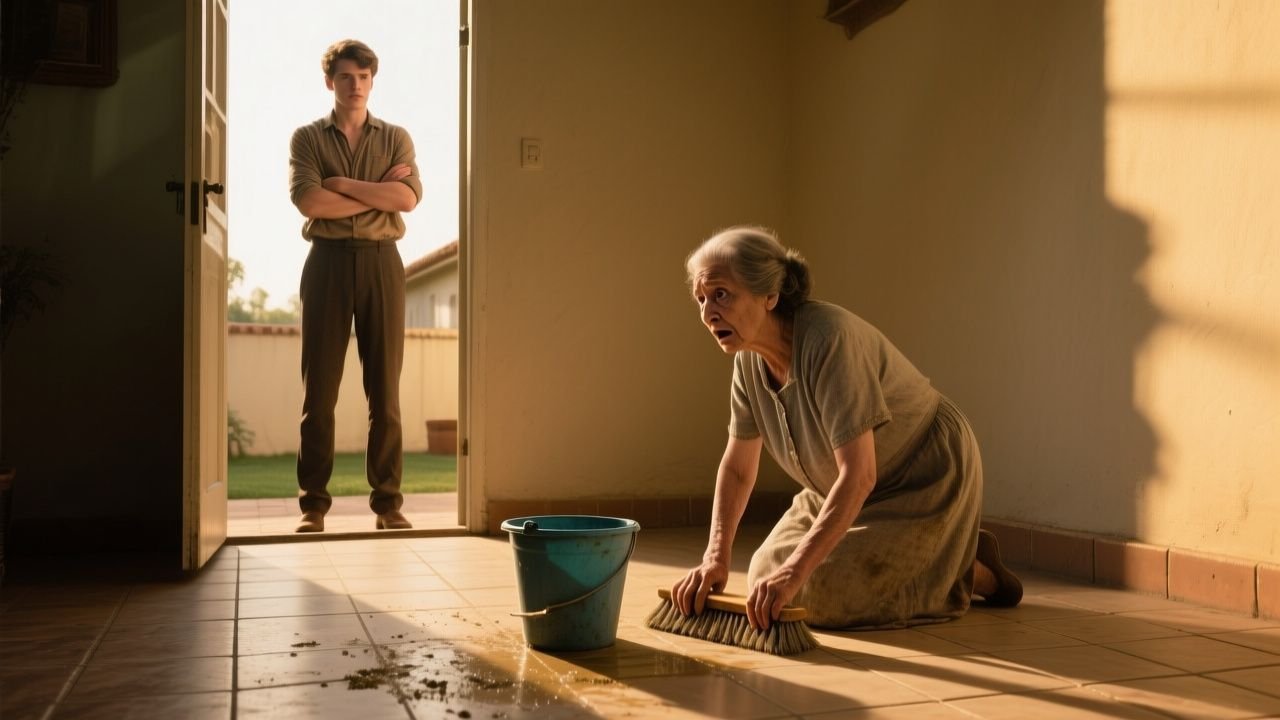
And then I saw the hallway leading to the patio, and I saw my mother.
She was on her knees.
—
She was wearing old clothes I had never seen before, pants that had been patched so many times their original color was impossible to determine, a shirt that hung loose on her too-thin frame. Her gray hair was pulled back in a bun that had partially come undone, wisps falling around a face I could barely recognize.
Her hands were submerged in a bucket of gray water, gripping a brush that she was using to scrub the stone tiles of the patio floor. Her back was bent at an angle that made my own spine ache in sympathy. Her breathing was labored.
She hadn't heard me enter. She hadn't heard my footsteps in the hallway or my sharp intake of breath. She was focused on her task, on the stains that she was trying to remove, on the labor that seemed to consume her entire existence.
I stood frozen in the corridor, watching the woman who had given me everything, the woman for whom I had crossed oceans and sacrificed my youth, the woman I had sworn would never work again, on her knees in the house I had bought for her.
The patio floor stretched out before her, perhaps ten square meters of stone that she was cleaning by hand. There was no bucket of clean water nearby, no mop, no tools that would have made the job easier. Just a brush, a bucket of water that had turned brown with dirt, and my mother's hands.
Those hands had once held me when I was small. They had prepared my meals and bandaged my wounds. They had applauded at my graduations and clutched a rosary at my father's funeral. They had done the work of a thousand women without ever asking for payment or thanks.
And now they were scrubbing the floor of a house that was supposed to be her sanctuary.
"Mamá."
The word came out as a whisper, cracked and broken. I wasn't sure I had said it aloud until she turned her head, her eyes wide with surprise, her body still frozen in its kneeling position.
"Alex?" Her voice was uncertain, as if she wasn't sure she was really seeing me. "Alex, what are you doing here? You're supposed to be in Dubai."
I crossed the distance between us in three strides and knelt beside her, taking the brush from her hands and tossing it into the bucket. I grabbed her shoulders, feeling how thin they had become, how fragile the bones beneath my fingers.
"Mamá, what is this? What are you doing?"
Her eyes, those beautiful brown eyes that had looked at me with unconditional love my entire life, filled with tears. But she didn't answer. She just shook her head, the way she did when she didn't want to burden me with her pain.
"Tell me what's happening," I demanded, my voice rising despite my best efforts to control it. "Why are you on your knees scrubbing this floor? Where are Lucía and Tomás? Why aren't they doing this?"
From behind me, I heard Tomás's voice, defensive and whining. "She wanted to do it. We told her she didn't have to, but she insisted."
I turned to look at him, standing in the doorway to the patio, his arms crossed over his chest. He looked like a man who was confident in his lies, who had perhaps repeated them so many times that he believed them.
"You told her she didn't have to?" I repeated, rising slowly to my feet. "And yet she's on her knees. And yet you're standing there in your underwear at three in the afternoon. Where's my sister? Where are the kids?"
"Lucía took the kids to her mother-in-law's house," Tomás said dismissively. "And I was just about to help her. I was getting dressed."
"Getting dressed." I looked at his bare feet, at his stained shirt, at the beard that hadn't been trimmed in weeks. "How long, Tomás? How long has she been cleaning your floors?"
He shrugged. "What does it matter? She likes to stay busy."
A sound escaped my throat, something between a laugh and a growl. The sound of a man who had spent eleven years saving every penny, had endured every hardship, had dreamed every night of giving his mother the life she deserved, only to discover that his brother-in-law had turned that dream into a nightmare.
"Mamá, get up." I turned back to my mother, my hands gentle but firm as I tried to lift her to her feet. "Get up right now. You're never cleaning this floor again."
She resisted, her body limp, her eyes downcast. "Alex, don't be angry. They're family. They need help."
"They need help?" I couldn't believe what I was hearing. "Mamá, I bought this house for you. For you to rest. For you to enjoy your garden. For you to have peace after everything you've been through. Not for this. Never for this."
"Your sister is struggling," she whispered. "Her husband has been going through a hard time. The children need stability. What kind of mother would I be if I—"
"A mother who takes care of herself," I interrupted. "A mother who deserves to be taken care of. A mother whose son worked himself nearly to death so she would never have to scrub another floor."
—
The next hour passed in a blur of confrontation and revelation. I called my sister, who returned home with the children, her face a mixture of guilt and defiance. I demanded explanations, I demanded answers, I demanded to understand how the woman who had been given everything had ended up with so little.
Lucía cried. She always cried when confronted, weaponizing her tears in a way that had worked on our mother for decades. She talked about her struggles, her failed job, the children's needs, the unfairness of a world that had never given her a chance.
"You had a chance," I reminded her, my voice ice-cold. "You had a house to live in. You had a mother who fed you and housed you and asked for nothing in return. And you took advantage of her. You turned her into your maid."
"That's not fair," she protested. "We helped her too. We paid the bills sometimes. We—"
"You paid nothing." The words came from my mother, surprising everyone in the room. She had risen from the floor, had washed her hands, had stood in the hallway listening to the argument. Her voice was quiet but steady. "The money Alex sends every month. That's what pays for everything. I've been using it to cover your expenses because you never found work."
The silence that followed was heavy, suffocating. Lucía's face paled, then reddened. Tomás studied the floor as if it held the secrets of the universe.
"The money I sent for your medicine," I said slowly, "for your food, for anything you needed. You've been supporting them with it?"
"They're my children too, Alex." My mother's voice cracked. "I couldn't let them starve."
"They weren't starving, Mamá. They were taking advantage of you. And you let them."
She didn't answer. She couldn't.
—
I gave them one week to leave.
I was calm when I said it, calmer than I felt. I explained that the house belonged to my mother, that legally it was in her name, that if she chose to let them stay she had every right. But I also made it clear that if I ever visited again and found her on her knees, cleaning up after able-bodied adults who could work but chose not to, I would take legal action to have them evicted.
Lucía tried to argue. Tomás tried to play the victim. The children, innocent and confused, watched their world collapse without understanding why.
My mother was silent through it all, her hands folded in her lap, her eyes fixed on a point somewhere in the middle distance. I wondered if she hated me for disrupting the peace, for forcing a confrontation she had spent years avoiding.
But when I went to her that night, when I sat on the edge of her bed in the small room she had been relegated to, she took my hand and held it tightly.
"I'm sorry," she whispered. "I'm sorry you had to see me like that."
I shook my head, fighting back tears. "You have nothing to apologize for. None of this is your fault."
"I should have told you. I should have asked for help."
"You shouldn't have needed to ask. I should have seen. I should have visited more often. I should have—"
"No." Her grip on my hand tightened. "You did everything right, Alex. You are a good son. The best son any mother could ask for. I just… I didn't know how to say no to your sister. I didn't know how to choose myself over my children."
"Please choose yourself now." The words came out heavy, desperate. "Please, Mamá. For me."
She was quiet for a long moment, her fingers tracing patterns on the back of my hand like she used to do when I was a child and couldn't sleep. Then she nodded, a small, tired movement that carried the weight of a lifetime of sacrifice.
"Okay," she said. "Okay."
—
The week passed slowly, tension hanging in the air like smoke. I stayed in the house, monitoring the packing, ensuring that Lucía and Tomás didn't take anything that didn't belong to them.
It was strange, living in the house I had bought, occupying the space I had intended for my mother's peaceful retirement. I noticed things I hadn't seen before. The way the kitchen cabinets were overflowing with food my mother didn't eat. The way the closets were filled with clothes that weren't hers. The way the entire house had been colonized by people who treated it as an inconvenience rather than a gift.
On the fifth day, I found my mother crying in the garden. She was standing among her wilted tomato plants, the ones she had planted with such hope years ago, now neglected and dying.
"I thought they would grow," she said when I approached. "I thought I would have time to take care of them."
"You'll have time now," I promised. "I'll help you replant them before I leave. We'll start fresh."
She looked at me, her eyes red and tired but holding something that looked almost like hope. "You're going back to Dubai?"
"In a few weeks. I need to sort things out there, finish my contracts, figure out the next steps. But I'll be back. And things will be different."
"Different how?"
"I don't know yet. But I'll make sure you're not alone again. I'll make sure no one takes advantage of you again. I promise."
She nodded slowly, then turned back to her dying tomatoes. I stood beside her, both of us silent, both of us staring at the garden that had become a symbol of everything that had gone wrong.
—
On the seventh day, Lucía and Tomás left.
Their departure was anything but graceful. There were accusations, recriminations, tears and slammed doors. Lucía told me I was cruel, that I didn't understand her struggles, that I had always been the favored child and always would be.
Maybe some of what she said was true. Maybe I had been favored, not by our mother's love, which she distributed equally, but by circumstance and luck and the simple fact that I had escaped while she had not.
But as I watched their car drive away, loaded with their belongings and their children and their resentment, I felt no guilt. I felt only relief, and underneath it, a profound sadness for what our family had become.
My mother stood beside me, her hand in mine. She didn't speak. She didn't cry. She simply watched them go, her expression unreadable.
"Are you okay?" I asked.
She was quiet for a long moment. Then she squeezed my hand and said, "I'm free."
—
I stayed three more weeks after Lucía left. We painted the walls, repaired the damages, restored the house to something approaching its original purpose. We planted new tomatoes in the garden, and this time I showed my mother how to set up an irrigation system so they would survive even when she forgot to water them.
We talked more than we had in years. She told me stories about my childhood that I had never heard. She confessed fears and regrets and dreams she had buried so deep she had almost forgotten them.
I told her about Dubai, about the heat and the loneliness and the endless work. I told her about Mariana, who had supported me through everything and who deserved more than a husband who was always far away. I told her about my own regrets, my own fears, my own dreams.
"You've given so much," she said to me one evening, as we sat on the patio she no longer had to scrub. "You've given more than anyone should have to give."
"I'd give it all again," I answered honestly. "Every bit of it. For you."
She smiled, a real smile, the kind that reached her eyes and made her look decades younger. "I know. That's what makes you special, Alex. That's why I'm proud to be your mother."
—
The flower shop had been in the family for thirty years.
The man who spoke walked with a slight limp, a consequence of an old construction injury, and his smile carried the weight of someone who had spent decades serving customers with gruff efficiency. His name was Ricardo, and he had known my mother since before I was born.They had dated in their youth, before my father came along, and had remained friends through all the years since. He had never married. Neither had she, after my father died. There had been something between them, I realized, that had never been allowed to fully bloom.
"When you left for Dubai," he continued, "she told me you were the bravest person she had ever known. She said you had a heart so big it exceeded the size of your body."
I didn't know what to say to that. What does a son say to a man who has loved his mother from a distance for thirty years?To now hear that she used my name as an anchor in her moments of despair, something cracked inside me. A wall built of guilt and separation for eleven years gave way. I had been thinking of her as the woman I left behind. But she was the woman who got up every morning and chose to keep going because of what she saw in me.
—
Mariana arrived two days before I was scheduled to return to Dubai. She had managed to arrange time off from the salon and had flown in as soon as I told her what had happened.
"I should have been here," she said, standing in the living room, looking around at the house that had been transformed. "I should have noticed something was wrong."
"We all should have," I answered. "But we're here now. That's what matters."
Mariana embraced my mother as if she were her own, whispering promises of future visits and future help. My mother accepted the embrace with visible emotion, and I could see how much it meant to her to have someone who loved me deeply also love her.
The three of us spent those last two days together, walking through the town, visiting old friends and familiar places. We ate at restaurants my mother had never been able to afford, and she ordered things she had never tried before, delighting in every new flavor.
"This is what I wanted," I said on our last evening, sitting on the patio as the sun set. "This is what I was working for all those years."
"There's time now," Mariana said, taking my hand. "Time to figure out what comes next. Time to build a life that includes her."
I looked at my mother, who was smiling at the horizon, her face peaceful for the first time in years. And I made a decision that had been forming in my heart since the moment I saw her on her knees.
I wasn't going back to Dubai.
—
The weeks that followed were a whirlwind of logistics and decisions. I had to return temporarily to finish my contracts and collect my final payments, but I would not renew anything. Mariana would stay in Spain, taking care of my mother while I sorted out the loose ends.
"Are you sure about this?" she asked me on my last night in Dubai, watching me pack.
"I'm more sure than I've been about anything in my life."
"What will we do for money?"
"We'll figure it out. I have savings. You have your salon connections. Maybe we open something here. Maybe I find work in construction locally. We'll manage."
She nodded, her face thoughtful. "You know, I always knew you would be the hardest to leave."
"What do you mean?"
"Dubai. The life we built here. It was good enough for a while, but it was never really ours. It was yours, for your mission. And now the mission is complete."
I pulled her into my arms, grateful for a wife who understood me better than I understood myself. "I love you."
"I love you too. Now come on. Let's finish this."
"I'm coming home, Mamá. I'm not leaving you alone again. I'm not letting anyone take advantage of you again. This house is your sanctuary, and I'm going to protect it with my life."
The line was silent for a moment. Then my mother's voice, weaker than I had ever heard it:
"You have always been the strongest person I know."
"Where did that come from?"
"I just want you to know," she said. "I want you to know that you are the light of my life."
—
On my final visit, three weeks before I returned for good, I found my mother sitting in the garden.
She was eighty-two now, her hair completely white, her face lined with decades of love and sacrifice. She had a small smile on her lips, the kind of smile that comes from a soul at peace. Her hands, the same hands that had once scrubbed floors in the house I bought for her, were now resting in her lap, no longer rough or bruised, but soft and cared for.
"Alex," she said, not turning to look at me, "do you see the tomatoes?"
I followed her gaze to the garden she had planted, where the tomato plants were heavy with fruit. She had tended to them every morning, had watched over them with a devotion that touched my heart.
"They're beautiful, Mamá."
"They remind me of you," she said, her voice barely above a whisper. "They grew despite everything. They thrived. They gave fruit when no one expected them to. Just like you."
I sat beside her, taking her hand. The sun was setting, painting the sky in shades of orange and pink, and I felt a peace I had not felt in years.
"I love you, Mamá."
"I love you too, my son. More than you will ever know."
—
My mother died three months later, in her sleep, in the house I had bought for her.
She was found by Mariana, who had stopped by for their usual morning coffee. The doctor said it was peaceful, that her heart had simply stopped beating after a lifetime of beating for others.
I was in Dubai when I got the call, wrapping up the final details of my departure. I sat on the floor of my apartment, surrounded by boxes, and I wept.
We buried her on a Thursday, under a sky that refused to match the grief on my heart. It was spring. The rain fell like gentle tears on the earth that would now hold my mother's body, as if the sky itself was crying.
We buried her beside the tomatoes she had loved in the garden of the house I had built, in the ground that had grown tomatoes for four harvests in her care. Just a week before she died, she had picked a basket full of them, had cooked a meal for the two of them, had laughed at a story Mariana told about the garden store.
Just a couple of weeks before she died, she picked the first tomato of the season and gave it to me, smiling as if it were the greatest gift she could ever give.
"The soil is good here," she told me. "It's just good soil."
I walked through the house after the funeral, touching the walls she had painted, looking at the furniture she had chosen, seeing in every corner the marks of her presence. She had been happy here, in the end. She had been at peace.
—
Lucía came to the funeral, alone. Tomás stayed home with the children, claiming he was too grief-stricken to attend. I didn't bother to challenge the lie.
We stood together at our mother's grave, two siblings who had once shared everything and now shared nothing but DNA and a dead parent. We didn't speak. We didn't embrace. We simply stood, each of us lost in our own private grief.
After the service, Lucía approached me. Her face was pale, her eyes red. She looked older than her years, worn down by choices she couldn't unmake.
"I'm sorry," she said. "For everything."
I looked at her for a long moment. "I know."
"We could have been closer. We could have been a family."
"We can still be a family."
She shook her head. "Too late. Too many things have happened."
"It's not too late," I insisted. "She would want us to find each other. She would want us to be siblings again."
Lucía looked at me, a single tear trailing down her cheek. "You were always better than me, Alex. You always did the right thing. I was always the screw-up, the one who needed help, the one who took and took and never gave back."
"That's not true."
"It is true. And I never hated you for it. I envied you. I resented you. But I never hated you."
"Then we can find our way back."
She considered this, her expression unreadable. Then she nodded, a small, uncertain movement.
"Maybe," she said. "Maybe we can."
—
I returned to the house one last time before leaving Spain for good.
The tomatoes had wilted, their fruit unpicked. I stood in the center of the garden, my heart heavy with grief and gratitude. I had been gone so long.
I had returned, I had fought, I had won. But in the end, the battle had been different. The battle had been for something else.
I looked at the tombstone. Just behind it, a single tomato plant had sprouted, uninvited, unattended. It grew wild in the soil my mother had loved, and it promised fruit that no one expected.
I turned and looked at the patio. It was clean. Immaculate. The way it should be.
Before I left, I knelt and picked a single tomato from the ground. It was small, imperfect, a little bruised from falling.
I put it in my pocket and walked away.
—
Some gifts are meant to protect the people we love. But the greatest gift, the one my mother gave me, was not a house or a garden or a truck. It was a mirror. She showed me who she was, and in doing so, she showed me who I needed to be.
As I drove away from the town where I was born, I realized the real gift was never the house. The real gift was time. Time to be her son. Time to stand beside her. All those years in a desert, every blister, every dirham, every sleepless night was worth this one thing: the absolute certainty that in her final years, she knew exactly who I was and that I loved her with my whole heart.
And that, after all the years and all the distance and all the pain, is more than most people ever get.