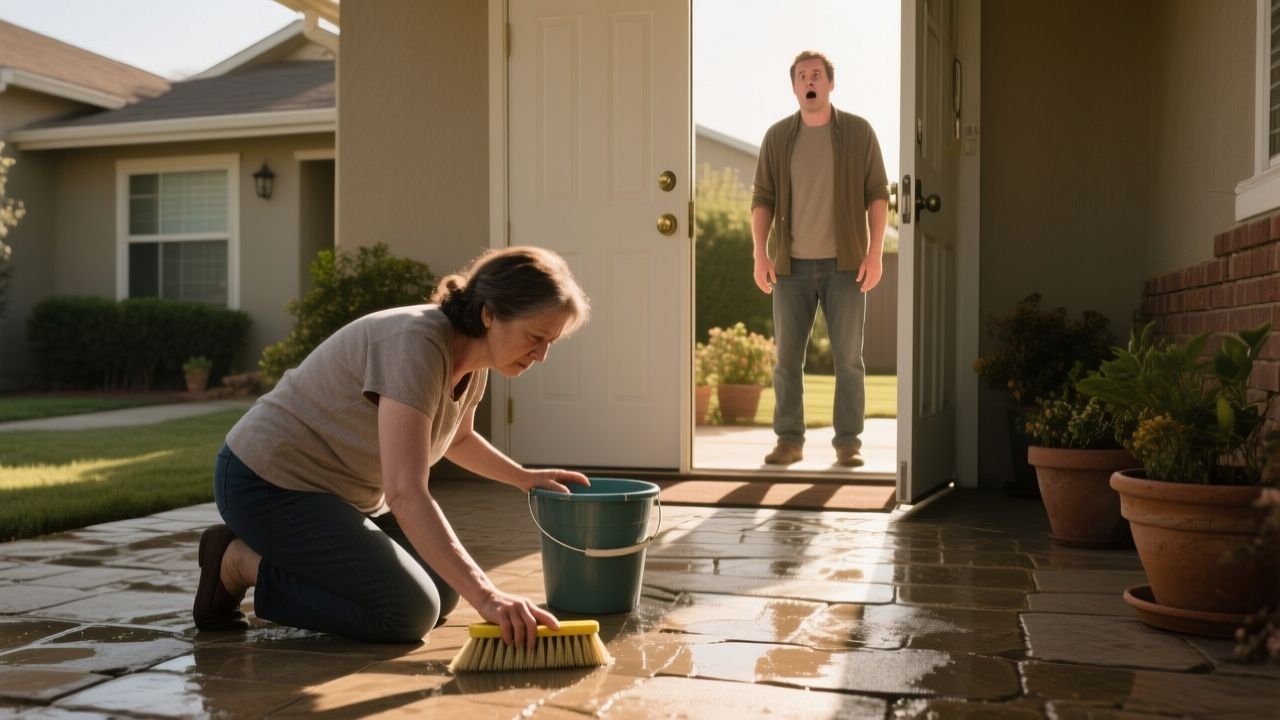
The scene you saw had a continuation, and this is where everything that happened before — and after — is finally revealed.
The key had barely turned in the lock when I heard it: the wet slap of a rag against stone, and the soft grunt of a woman working on her knees.
I had spent eleven months in Dubai saving for that house. Eleven months of fifty-degree heat, of twelve-hour shifts, of eating rice and eggs in a shared apartment so I could send money home every two weeks without fail.
And now, standing on the other side of my own front door at four in the afternoon — a month earlier than anyone expected — I heard my mother breathing hard on the floor of the patio she was supposed to be enjoying from a plastic chair, not scrubbing like a hired maid.
Then the door swung open, and Iván appeared.
My brother-in-law. My sister Marcela's husband. Standing in the doorway of the house I had bought for my mother, holding a glass of lemonade, wearing flip-flops and the kind of relaxed expression a man wears when he owns the place.
"Ah," he said. "You're back."
Behind him, my mother didn't even turn around. She kept scrubbing.
—
I need to take you back, because nothing about that moment makes sense unless you understand the year before it.
My name is Andrés, and I'm thirty-four. I grew up in a working-class neighborhood where my mother, Elvira, raised two kids alone after my father left. She cleaned other people's houses for twenty-two years so that Marcela and I could eat.
Her knees are shot. When I was a teenager, I used to hear her cry quietly in the bathroom at night, pressing hot towels on them. She never complained in front of us. Not once.
I promised myself, the day I got my first real paycheck, that one day I would buy her a house with a big patio — she always wanted a patio full of plants and a hammock — and a door she could lock with her own key.
That promise took fifteen years.
—
Dubai happened because a friend of a friend needed welders for a construction project, and the pay was triple what I earned at home. I had a girlfriend, Paola, and I had a modest apartment, and I had a life. But I did the math.
Three years of work there, and my mother would never scrub another floor.
I told Paola first.
"Three years is a long time," she said, quiet, sitting on the edge of my bed.
"It's three years for thirty years of hers," I answered.
She didn't argue. That's the kind of person she is. She just held my hand and said, "Then we do it right. We save. We don't touch the money. That money is your mother's."
And we did. Both of us. She stayed here, working, and every month she'd send me photos of the little apartment she was keeping for us, plants on the balcony, waiting.
—
I came back for the first time after two years and four months. Not for good — just a month of vacation.
The first thing I did with my savings was close the deal on a small house on a quiet street, three bedrooms, a big patio with a mango tree, and a front door painted green because my mother once said green doors bring luck.
I put it in her name. Only hers. I signed the papers with a notary and I remember my hand shaking slightly, not from nerves, but from a kind of emotion I don't have words for.
The day I gave her the keys, she didn't understand at first.
"What is this?" she asked, holding them like they might burn her.
"It's yours, Mamá. The patio has a mango tree."
She looked at the keys, then at me, then at the keys again.
"Son," she whispered. "I don't deserve this."
"You deserve a thousand of these," I said, and she hugged me so hard I felt her whole body trembling.
That night I flew back to Dubai with a lighter heart than I'd had in years.
—
What I didn't know — what I found out much later, piece by piece — is that Marcela and Iván had been going through a rough stretch. He'd lost his job at the warehouse, and then another one, and then stopped looking with any real urgency.
Marcela called me one night, three months after I bought the house.
"Andrés, I need to ask you something and please don't say no immediately."
"Tell me."
"Iván and I need a place to stay. Just for a few months, until he finds something. We can't cover rent anymore. And Mamá's house has two empty rooms…"
I hesitated. I want to be honest about that, because now everyone asks me why I said yes, and the truth is I almost didn't.
"Marcela, that house is for Mamá. It's her peace. I don't want her taking care of you two."
"She won't lift a finger! I swear. And we'd help with the bills. Iván's already looking at a job in the north."
I said yes because she's my sister. Because we grew up sharing one plate of food. Because I remembered her at twelve years old, sewing my school uniform by hand.
That's why I said yes. That's the whole reason.
—
The months passed, and the story over the phone started to change shape.
At first, Marcela told me everything was fine. Then she started calling less. Then, when she did call, she sounded tired in a way that had nothing to do with work.
"How's Mamá?" I'd ask.
"She's fine. She's fine."
"And Iván? Did he get the job in the north?"
Silence.
"He's… figuring things out," she'd say, and change the subject.
My mother, for her part, always said the same thing when I called her: "Everything's good, son. Don't worry about us. You just take care of yourself over there."
That sentence — "don't worry about us" — is the sentence I should have listened to differently. My mother has said it her whole life. It's never once meant that things were good.
—
Now let me take you back to that front door, because the moment deserves to be told slowly.
I had landed that morning. I hadn't told anyone. The plan was simple: I wanted to surprise my mother. I wanted to walk in, find her in the hammock with a cup of coffee, and see her face when she realized I was home a month early.
I took a taxi from the airport. I stopped at a bakery and bought the sweet bread she likes. I rehearsed the joke I was going to make at the door: "Ma'am, I'm collecting donations for the mango tree fund."
I walked up the street and I saw the green door, and I felt that thing in my chest — pride, I guess, the quiet pride of a son who kept a promise.
I put the key in the lock.
And then I heard the scrubbing.
—
The rag sound is what I remember most. That wet, rhythmic slap. And under it, my mother's breath, heavy, the breath of a woman in her sixties doing work she shouldn't be doing on her knees.
I opened the door.
The patio is straight ahead from the entrance. And there she was: my mother, on her knees on the wet stone, in an old floral apron I hadn't seen since I was a kid, her hair tied back with a cloth, scrubbing a stain near the drain.
Elvira, who I had crossed an ocean for. On her knees. Cleaning.
"Ma?" I said.
She froze. She didn't turn around.
And that's when Iván came to the door.
—
"Ah," he said. "You're back."
He was holding a glass of lemonade. Ice clinking. He was wearing flip-flops and shorts, and he looked tanned, relaxed, like a man on vacation in a house that wasn't his.
"Where's Marcela?" I asked.
"At her mother's," he said. "She went this morning."
"My mother is right there," I said, pointing at the patio. "What is she doing?"
Iván took a sip of the lemonade.
"She wanted to clean it," he said. "You know how she is. She doesn't sit still."
It was the smoothest sentence I had ever heard. It slipped out of his mouth like something he'd practiced, and the worst part is that it almost worked — because for one second I believed him. My mother has never sat still. That's true. That's the most true thing about her.
But then I looked at the patio again.
—
The floor was spotless. Every corner. Every tile. The drain grate was gleaming.
Nobody scrubs a floor that clean "because they don't sit still."
"Ma," I said, walking past Iván. "Ma, stand up. Come here."
She stood up slowly, and I saw her wince. I saw her press one hand to the wall to get up, and I saw her knuckles, cracked and red from water.
She turned around and looked at me, and her eyes were wet.
"Son," she said. "You came early."
"Why are you cleaning this floor?" I asked.
"Because it was dirty."
"Ma."
"It was dirty, son."
I looked at Iván. He was still holding the glass, watching us like we were a television show he'd already seen.
"Where are your kids?" I asked him. "Where's Mateo? Where's Lucía?"
"At school," he said.
"And who picks them up?"
He paused.
"She does," he said, nodding at my mother. "She likes it. They're her grandkids."
—
I want to describe what happened next, but I have to be careful, because I don't want to make myself look better than I was.
I am, at that moment, not a good man. I am an exhausted man who hasn't slept on a plane in twelve hours, standing in a house he paid for with blood, looking at his mother with red knuckles and his brother-in-law with a lemonade.
I took the glass out of Iván's hand.
I set it on the table.
And I said, very quietly, "Sit down. We're going to talk."
He sat. I'll give him that — he sat.
—
"Explain it to me," I said. "Month by month. Because I've been calling every Sunday for eight months and every Sunday I've been told everything is fine."
Iván looked at the table.
"Things got hard," he said.
"Things got hard for who? Because from here it looks like things got hard for my mother, and things got very soft for you."
"Don't talk to me like that."
"I'll talk to you however I want in a house I paid for. Why is she cleaning? Why is she picking up your kids? Why does my sister sound like a widow on the phone?"
He didn't answer the first question. He answered the third one.
"Marcela's tired," he said. "She's been tired for a while."
—
And that's when my mother spoke. She had been standing behind me the whole time, still with the rag in her hand, and she said — quietly, the way she says everything difficult — the sentence that broke my heart into a hundred pieces.
"Son, don't fight," she said. "They had nowhere to go. And I have a big house. God gave me a big house so I could share it."
I turned around.
"God didn't give you this house, Ma. I gave you this house. And I gave it to you so you would never have to kneel on a floor again in your life."
She looked at the rag in her hand like she was seeing it for the first time.
Then she started to cry. And when my mother cries, she cries without sound, which is worse.
—
I learned the rest over the following days, and I'm going to tell you all of it, because it's the part nobody saw.
Iván had not been looking for work. Not for months. He had picked up odd jobs, cash jobs, and he had spent most of the money on things I won't detail here. What I will say is that Marcela had been working two shifts — one at a call center, one at a bakery — while he stayed home "figuring things out."
My mother, who had promised me she wouldn't lift a finger, was cooking for four extra people, washing for four extra people, picking up two kids from school every day, and cleaning the house every morning before anyone woke up, because Iván complained if things weren't done by the time he got up.
And she never told me. Not once. Because she believed — and this is the part that destroys me — that telling me would mean admitting that she had failed me somehow.
"She's your sister, son," she kept saying. "Blood is blood."
—
I called Marcela that same night.
She arrived at ten o'clock, coming out of the bakery shift, still in her work shirt, flour in her hair.
When she saw me, she stopped in the doorway.
"You came early," she said.
"I did."
She looked past me, at our mother, asleep in the armchair in the living room. Then she looked at the patio, and her face did something complicated — shame and exhaustion and a strange kind of relief, all at once.
"How long have you known?" she asked.
"Two hours."
She nodded slowly. Then she sat on the step and put her face in her hands.
—
I sat down next to her, and I'm not going to pretend I was gentle. I was angry. Very angry. But I was also her little brother, the one she'd sewn a uniform for, and when she started to talk, I listened.
"He wasn't always like this," she said. "Two years ago he was a good man. When he lost the first job, he cried in the bathroom. He was ashamed. And then the second one, and then he stopped saying anything at all."
"And the money?"
She went quiet.
"Where's your money, Marcela?"
"At home. In an account. I've been saving. For the kids."
"Does he know about it?"
She shook her head. And that one gesture told me everything about the state of her marriage — a woman keeping a secret account because she no longer trusted the man she slept next to.
—
"Then why are you still here?" I asked.
"Because leaving means admitting my mother was right about him. Because of the kids. Because I'm tired, Andrés. I'm so tired I can't even remember what it felt like to want something."
I understood her. That's what I keep coming back to, all these months later — I understood her.
Which is why I chose the next morning's conversation carefully.
—
I woke up at six. My mother was already in the kitchen. Of course she was.
We talked with the coffee between us, and for the first time in my adult life, I spoke to her like an equal, not like a son protecting a mother.
"Ma, I need you to do something for me, and I need you to actually do it."
"Anything, son."
"I need you to stop."
She looked at me.
"I need you to stop cooking for them, stop cleaning for them, stop picking up their children. Not forever. Just until they learn to stand up. You can love them and still let them struggle."
"Son, I can't watch my daughter drown."
"She's not drowning, Ma. She's holding up her husband while he lies down. That's different. And you're the one who's drowning — I saw it yesterday. Your knees. Your hands. You're sixty-three."
She was quiet for a long moment.
Then she said, "I was so afraid you'd be disappointed in me."
"Disappointed? Ma, I crossed an ocean for you. I built you this house so you could sit. Sit. That's all I want. Sit down."
She laughed a little — a wet, surprised laugh — and I knew we had agreed on something.
—
Iván woke up at eleven.
I was sitting at the kitchen table with his coffee and his options in front of me.
"Good morning," I said.
"Morning."
"Sit down. Two things."
He sat. He looked smaller in the daylight. That's the thing about men like Iván — they only look big in dim rooms.
"First: thirty days. You have thirty days to find work and start contributing. Real work. Second: starting today, my mother doesn't pick up your kids, doesn't clean your room, doesn't wash your clothes. Those are your kids. That's your mess."
He stared at me.
"Or what?"
"Or you leave the house. It's her house, Iván. Not yours. Not Marcela's. Hers. And she can ask you to leave any time she wants."
He opened his mouth to argue. Then he looked at my face, and closed it.
—
The thirty days were not peaceful.
Iván spent the first week in silence, the second week in a kind of angry fog, and the third week — after Marcela told him she knew about the secret account, after she told him she would leave if things didn't change — he did something I didn't expect.
He got a job. Not in the north. Right here in the neighborhood. A warehouse. Night shift. Hard, badly paid, exactly the kind of job he had once thought was beneath him.
He started going. Every night. And in the mornings he came home tired, and for the first time in months, he didn't complain about anything.
I don't know if that's a happy ending. I don't know if a man changes at forty-one. But I know what I saw, and I'm not going to pretend it didn't happen.
—
Marcela and I had a long conversation in the third week, in the patio, under the mango tree.
"He's trying," she said.
"He is," I said. "And you have an account. Remember that."
She laughed. "That's a very cold thing for a little brother to say."
"It's the warmest thing I know how to give you," I said. "A way out that's always there. So you never stay somewhere out of fear again."
She got quiet. Then she hugged me the way she used to when we were kids, and I felt her relax for the first time in years.
—
My mother, for her part, had to learn to sit down. I swear to you, that was the hardest part of this whole story.
The first week, I'd find her standing next to a chair, uncomfortable with nothing to do, like a soldier in peacetime. She'd ask me three times a day if I wanted her to cook something. I'd say no. She'd ask again.
I bought her a hammock on day four. It took me and her two hours to figure out how to hang it, and when she finally sat in it, with her coffee, and the mango tree above her, and her son home, she looked up at the leaves and said:
"Son, is this real? Am I allowed to do this?"
"Ma," I said. "That's the whole point. That's the entire point of this house."
—
I stayed for two months total — the extra weeks were mine to take, and I took them. I fixed the patio drain that Iván had never bothered to fix. I planted two more trees with my mother. I took my niece and nephew to school some days, so she'd know it wasn't about not loving them.
And when I finally left for Dubai again — yes, I went back; I still had a contract to close — I left with a different kind of lightness than the first time.
Not because everything was solved.
Because I had finally understood something I should have understood years earlier.
—
I kept hearing people ask me, all that year, "Why didn't your mother tell you?"
And the answer is what I want you to take away from this, more than anything else.
She didn't tell me because silence was the only way she had to feel strong. When you spend your whole life being needed, being needed becomes your identity. Letting go of that — even when your knees are broken — feels like losing yourself.
My mother didn't need a house to be free.
She needed permission to stop being everyone's floor.
—
The ending of this story is quiet, and that's how I know it's real.
Last month I called her, and she was in the hammock. I could hear it in her voice — the swaying, the little creak of the rope.
"Son, the mango tree has its first fruit," she said.
"You'll have to wait until I get there to eat it."
"Then I'll wait," she said. "I learned how to wait."
And then she laughed — a big, easy laugh — and I heard it, twelve thousand kilometers away, sitting on the floor of a rented room in Dubai, and I cried.
Not because I was sad.
Because I finally knew what it sounded like when my mother was free.