That moment that stopped your scroll is only half the story, and the rest of it starts right here.
Marta had never imagined she'd end up standing in front of her grandmother's front door, holding a dusty cardboard box that smelled like old cedar and forgotten dreams. Her car was still running in the driveway, its engine ticking with the soft impatience of someone who thought this errand would take ten minutes, maybe fifteen at most. She'd been dreading this visit for weeks, ever since the lawyer's letter had arrived.
She knocked, more out of habit than necessity, and let herself in. The house was quiet the way only an eighty-year-old house can be quiet, with its creaking floors and the clock on the wall that had been ticking since before Marta was born.
And there, on the floor of the hallway, right where her grandmother had left them three months ago, sat the skates.
They looked like something pulled from a dumpster. The leather was cracked in a dozen places, gray where it should have been white or brown. The laces were frayed and knotted so many times they'd become a patchwork of repairs. The wheels were yellowed with age, the bearings rusted from years of moisture and neglect.
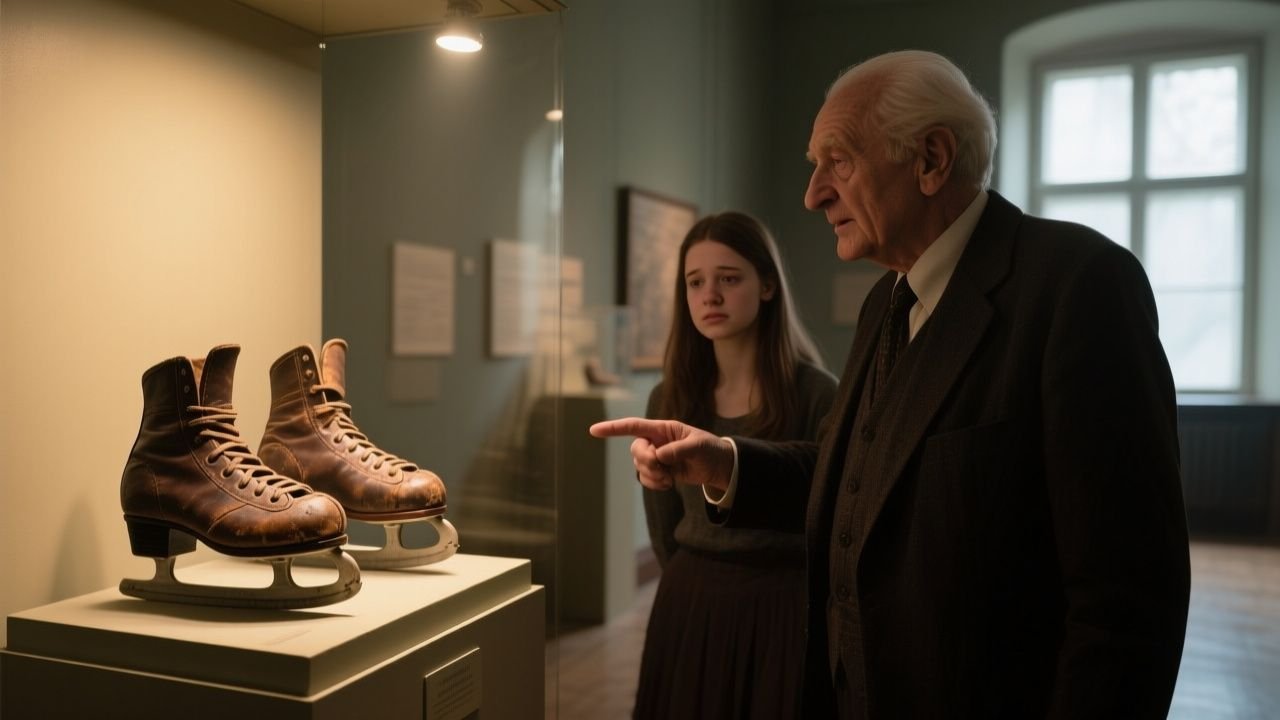
They belonged in a museum, Marta thought.
Not because they were precious, but because they were the kind of thing that should be preserved behind glass, kept away from anyone foolish enough to try to use them. They were a relic. A fossil. A reminder of a time long gone.
Her grandmother had called them the most important thing she owned. Marta had always found that embarrassing, almost shameful. When she was younger, she'd told her friends her grandmother was a librarian. It was true, after all. It was also safe. It was the kind of thing that didn't invite questions.
She hadn't told them about the old woman who spent every evening, even in retirement, in the garage with the door open, skating in slow, deliberate circles on rollers so worn they squeaked.
Marta's mother had called it a harmless hobby. The doctors had called it a minor obsession. Marta's cousin had called it sad, the way she said it behind her hand at family dinners, the word slipping out like a greased coin.
But Marta never called it anything.
She just watched, year after year, as her grandmother circled that garage like she was searching for something she'd lost. There were moves, though. Strange, graceful moves that didn't belong in a garage. Twirls that seemed to lift her off the ground. Jumps that Marta would have called basketball shots if she hadn't known better.
She'd asked once, when she was ten, why her grandmother didn't skate somewhere else. Somewhere with ice, maybe. The old woman had smiled and said the garage was enough. The old woman had said the old garage was enough. She had always said the garage was enough.
Marta hadn't understood then. She didn't understand now. She'd spent her whole life not understanding, really, and she'd made peace with that.
The box in her hands suddenly felt heavy. She put it on the kitchen table and started opening cabinets, looking for anything that might be worth keeping. The lawyer had said the house would be sold. The lawyer had said everything inside should be appraised before the estate moved forward.
The lawyer had been polite and efficient and completely, utterly indifferent.
"Most of it's junk," Marta said aloud, to no one. The sound of her own voice in the empty house startled her, and she laughed, a small, humorless laugh.
She went to the garage first. It was cleaner than she expected, the tools hung neatly on pegboards, the floor swept. And in the center of it, worn into the concrete by decades of repetitive motion, was a circle. A perfect circle, the kind that only comes from years of the same movement, thousands of hours of the same thing, day after day after day.
She stood in the middle of it.
She had never stood in the middle of it.
It felt strange, almost sacred. Like standing on a stage after the lights have gone out, when the applause has faded and the audience has gone home.
She didn't know how long she stood there. Long enough for the sun to move across the garage floor, casting the circle half in light and half in shadow. She thought about her grandmother, alone in this house for fifteen years after her husband died, coming out here every night with a broom and a bucket and those ridiculous skates.
She thought about the sound of the wheels on concrete.
She thought about the way the old woman had always smiled when Marta asked what she did all day, that sad, secret smile that seemed to say oh, you know, the usual.
She didn't know. She had never known.
She went back inside and that's when she saw it, tucked into the gap between the fridge and the wall, where someone had probably tried to hide it a very long time ago. It was a photograph, faded and stiff, but she pulled it out and held it up to the light.
And everything she'd thought in her life, everything she'd assumed about her grandmother, everything she'd ever believed about that circle in the garage, went still.
The woman in the photo was young. Maybe twenty, maybe twenty-two. She had her grandmother's eyes, the same bright blue, the same knowing look. She was standing on ice, one skate lifted, her arms above her head in a pose that Marta knew instantly, instinctively, was not something a hobby skater learns.
The photo was black and white, but it was clearly taken in a stadium. There were flags in the background. There were crowds in the stands. And at the bottom, in careful handwriting, someone had written a date: March 1958. And a name that Marta had never, ever heard before.
She sat down on the kitchen floor, right there in the middle of the day, and she stared at that photograph for a very long time.
She didn't know. She had never known.
And for the first time in her life, she wondered if maybe, just maybe, she had been looking at the wrong thing all along.
—
The Phone Call
It took her two days to make the call.
Two days of staring at the photograph. Two days of googling every combination of names and dates she could think of. Two days of finding almost nothing, just a tiny mention in a newspaper archive so obscure the search engine had placed it on page seven of the results.
"Vera Kovacs, 19, wins the regional championship at the Winter Palace Ice Rink. A promising young skater from the small town of Hontsdorf, she is expected to compete at the national level later this season."
Vera Kovacs.
Vera.
Marta had known her grandmother as Vera Novak. The last name was different by a single letter, but it was different. She'd known her as the quiet old woman who, when asked about her past, always said the war had taken everything and she didn't like to talk about it.
She made the call to the only person she could think of: the woman her grandmother had mentioned dozens of times but never once introduced. An old friend, she'd said, from the old country. A woman named Klara.
The phone rang four times. A woman's voice answered, frail and accented, saying hello in a way that made Marta's throat close up.
"Mrs. Weiss? My name is Marta. I'm Vera Novak's granddaughter."
There was a long silence on the other end of the line. So long that Marta checked to make sure the call hadn't dropped.
"Vera," the woman said, finally. "You're Vera's girl."
"Yes. I'm sorry to call out of the blue. I found some things in her house, and I had some questions. I was hoping you could help me."
Another long silence. Marta could hear the woman breathing, slow and careful, like she was deciding something.
"What did you find?" the woman asked.
"A photograph. Of a skater. A girl who looks just like her, at a competition. And some old skates."
The woman on the other end of the line made a sound that Marta had never heard before. Not quite a sob, not quite a laugh, something in between, something ancient and broken and full.
"She kept them," the woman said. "All this time. She kept them."
"Ma'am, I don't understand. Was my grandmother a skater?"
"Oh, child," the woman said, and her voice cracked. "Your grandmother was not a skater. Your grandmother was a miracle."
Marta sat down on the edge of the bed. The word miracle landed in her chest like a stone, heavy and impossible.
"I don't understand," she said.
"I know. She never told you. She never told anyone. That was the deal she made with the world." The woman paused, and Marta could hear the sound of a chair creaking, as if the woman was settling in for a long conversation. "You should come see me. I have things to show you. Things she left with me a long, long time ago, in case anyone ever came asking."
Marta looked at her calendar. She had a job she hated. She had a partner who had been asking, for months, why she was so distant. She had a life that felt like it had been borrowed from someone else, someone who was better at living it.
"When?" she said.
"Tomorrow. Come tomorrow. It's not far."
—
The House on the Hill
Klara Weiss lived in a small house at the end of a long gravel road, a house that seemed to have been forgotten by the rest of the world. Marta parked behind a rusted pickup truck and walked up the path, her heart pounding in her chest for reasons she couldn't explain.
The woman who opened the door was tiny and hunched, her white hair pulled back in a braid, her eyes the kind of pale blue that seems to look through you, not at you.
"You look like her," Klara said, by way of greeting. "Same eyes. Same stubborn chin."
"Thank you," Marta said, not knowing what else to say.
Klara led her into a small living room that smelled of tea and old books. There were photographs on every wall, but Marta's eyes went straight to one in the corner. A young woman, her grandmother, standing on a podium with a medal around her neck. Next to her, a girl with dark hair and a wide smile, holding a bouquet of flowers.
"That's you," Marta said.
"That's me," Klara said. "I was her training partner. Her friend. Her sister, in every way that mattered."
She gestured for Marta to sit, then lowered herself into the chair across from her with the careful deliberation of someone who has been fighting gravity for a very long time.
"I met your grandmother when she was fifteen years old," Klara said. "She came to the rink in our town because her parents had heard she had talent. They were right. She had more than talent. She had something that cannot be taught. Something that made everyone stop and watch."
Marta leaned forward. The house was so quiet she could hear the ticking of a clock in another room.
"She was the best," Klara continued. "There was no one like her. In 1957, she won the regional championship. In 1958, she was invited to compete at the national level. The photograph you found was taken at that competition."
"But she didn't compete," Marta said. "There's no record of it."
Klara's face darkened. She looked down at her hands, twisted in her lap, and was silent for a long moment.
"No," she said. "She didn't compete."
"What happened?"
Klara looked up, and Marta saw something in her eyes that made her stomach clench. Grief. Rage. And beneath all of it, a fierce and terrible love.
"The judges happened," Klara said. "The politics happened. The country happened. And a girl who should have been a star was told, by people who had no right to tell her anything, that she would never skate again."
Marta didn't understand. "What do you mean?"
"I mean she was disqualified. Before the competition even began. She was told her documents were not in order. That she was not a citizen. That she had no right to compete." Klara's voice was bitter, clipped, each word a stone. "It was a lie. Everyone knew it was a lie. But someone had decided that Vera Kovacs was not going to be allowed to win."
"Why?"
Klara looked at her, and for the first time, Marta saw something almost like a smile on the old woman's face. Not a happy smile. A bitter one. The smile of someone who has been carrying a story for sixty years and has finally found someone to tell it to.
"Because there was a skater from a powerful family, a girl who was expected to win. And your grandmother was better. She was so much better that no one could pretend otherwise. So they found a way to make her disappear."
Marta felt her hands clench into fists. "That's not fair."
"No," Klara said softly. "It was not fair. It was never fair. That is the lesson your grandmother learned, at nineteen years old, and that is the lesson she carried for the rest of her life."
She reached over to a small wooden box on the table beside her and opened it. Inside were dozens of photographs, all black and white, all of a girl on ice. A girl who looked like she had been born to fly.
"She left them with me," Klara said, "when she left the country. She couldn't take them with her. She couldn't take anything. But she asked me to keep them safe, in case anyone ever asked."
"Asked what?"
"Asked who she was. Asked what she had lost. Asked why she never spoke of her life before she came here." Klara looked at Marta, and her eyes were bright with tears she did not bother to wipe away.
"She asked me to remember. In case she forgot."
—
The Weight of Silence
Marta spent the rest of the afternoon in Klara's living room, listening to a story she had never known.
She learned that her grandmother had left her country at twenty years old, carrying nothing but a small suitcase, a broken heart, and a pair of skates she could not bear to throw away.
She learned that she had arrived here with no money, no family, no friends. She had found work in a bakery, then in a factory, then in a library. She had learned the language. She had learned to smile the way people wanted her to smile. She had learned to say oh, you know, the usual when anyone asked what she did in her free time.
She learned that she had met Marta's grandfather at a dance hall in 1962. He was a quiet man, kind and unremarkable, who had loved her with a steady devotion that seemed to surprise her every day. He had known, Klara said, about the skates. He had never asked questions. He had simply built her a rink in the garage, one winter, with his own hands, and told her that if she couldn't skate for the world, she could at least skate for herself.
Marta thought of that circle in the concrete, worn smooth by decades of the same movement. She thought of the sound the skates made, that soft, rhythmic squeak that she had heard so many times without ever really hearing it.
She thought of all the years she had stayed silent. All the questions she had never asked. All the ways she had let a woman slip through her fingers, thinking there was nothing there to hold.
"She used to practice at night," Klara said. "Did you know that?"
"She did," Marta said. "In the garage. Every night."
"She never stopped. She couldn't stop. It was the only place she could be who she really was." Klara's voice was soft, almost a whisper. "You know, child, there is a thing that happens to skaters when they are truly great. They don't skate on ice. They skate on something else. Something inside them. When your grandmother was on the ice, she was not a girl from a small town. She was not a competitor. She was not even a person. She was something else entirely."
Marta felt her eyes burning. "What was she?"
"She was free," Klara said. "For those few minutes, she was free."
She opened her mouth to ask more, but Klara held up a hand.
"I have one more thing to show you," the old woman said.
She stood, slowly, and walked to the back room. Marta heard the sound of drawers opening, the rustle of paper. Then Klara returned, holding something in her hands. Something wrapped in a soft, faded cloth.
She set it on the table between them and unwrapped it.
It was a pair of skates.
Old, cracked, almost falling apart. The leather was worn to the point of transparency in places. The laces had been replaced so many times they were barely laces at all. The blades were rusted, dull, ruined.
They were not the same skates Marta had found in her grandmother's house. These were different. These were older. These were the skates her grandmother had worn on the ice, sixty years ago, when she was young, when she was beautiful, when she was the best.
"She left them with me because she couldn't bear to keep them," Klara said. "She said they were the only thing that ever truly belonged to her. And the only thing she ever truly had to give up."
Marta reached out and touched them. They were cold under her fingers. Cold and heavy and utterly, impossibly fragile.
"They look like they belong in a museum," she said, and the words caught in her throat.
Klara looked at her, and for a moment there was something like a smile on her face. A real smile. A sad, tired, beautiful smile.
"They do," she said. "But not because they are old. Because they are proof. They are proof that a girl once lived, and loved, and lost. And kept going anyway."
She looked down at the skates, then back at Marta.
"There are times, you know, when I think about how different things could have been. If the judges had not been corrupt. If the world had been fair. If your grandmother had been allowed to be who she was."
She paused.
"But then I think about you. And all the other children she never spoke to, never told, never burdened with a past that was not their own. And I think about all the nights she spent in that garage, alone, doing the only thing that made her feel like herself."
She reached across the table and took Marta's hand. Her grip was surprisingly strong.
"She was not a skater," Klara said. "She was everything she ever needed to be. And she was happy. She had a family. She had a home. She had a life. The world tried to take her dreams away, and she built new ones. And she built them so well, so quietly, that none of us knew."
She squeezed Marta's hand.
"She was a miracle," she said. "And she was ours."
Marta sat there for a long time, holding the old woman's hand, looking at the skates, thinking about the circle in the garage floor. She thought about all the years she had spent not asking. All the years she had spent not knowing. All the years she had wasted, thinking her grandmother was a small, quiet woman with nothing to say.
She was not small.
She was not quiet.
She was a fighter, a survivor, a woman who had lost everything and built something new. She was a woman who had been told she would never skate again, and who had skated anyway, in a garage, in the dark, for sixty years.
She was a legend, hidden in plain sight.
And Marta had missed it. All of it. Every single day of her life.
She looked down at the skates one last time. And then she said the only thing that made sense.
"Thank you," she said. "Thank you for remembering."
Klara smiled, and the smile was tired, and sad, and full.
"Someone had to," she said. "I'm just glad it was you who came."
—
The Circle in the Concrete
Marta went back the next day. Not to Klara's house, but to the other one. The one she had walked away from two days before, thinking it was just a house, just a life, just a chapter that had already closed.
She walked through the front door and stood in the hallway, looking at the skates where they had been sitting when she first arrived. She picked them up. They were heavier than she remembered, but not by much. They were just old. Just worn. Just impossible.
She took them out to the garage.
The circle was still there. The afternoon light fell across it, catching the edges of the worn concrete, casting the shadow of the empty driveway across the half of it that was not in the sun.
She set the skates down in the middle of the circle. Then she sat down on the floor beside them, her back against the wall, and she looked at them for a long time.
She had never asked. That was the thing that haunted her. She had never asked. She had spent every Thanksgiving, every Christmas, every birthday, every boring Sunday afternoon of her childhood sitting in this woman's house, and she had never once asked the question that mattered.
Who are you?
She had thought she knew. She had thought her grandmother was a quiet, ordinary woman who had lived a quiet, ordinary life. She had thought there was nothing more to know.
She had been wrong.
She had been wrong about so many things.
She thought about the day she had brought her first boyfriend to meet her grandmother. He had been nervous, awkward, trying too hard. Her grandmother had smiled at him and asked him about his studies, and he had mumbled something about business school and looked at the clock.
Later, after he left, her grandmother had said, "He's very handsome."
Marta had rolled her eyes. "He's boring."
And her grandmother had said, "Maybe. But he's kind. Kindness is worth more than fire."
Marta had not understood that then. She had wanted fire. She had wanted someone who would make her feel alive, someone who would take her places, someone who would be more than ordinary.
She had gotten her grandmother instead. A woman who had been all of those things, and who had learned to be none of them.
She picked up one of the skates and turned it over in her hands. The blade was dull and rusted, but she could still see the shape of it, the curve, the edge. This was a blade that had been sharpened a thousand times. This was a blade that had known ice.
She thought about her grandmother, nineteen years old, standing in a stadium with flags and crowds. She thought about the moment she had been told she could not compete. She thought about what that must have felt like, to have everything taken away by people who had never even seen her skate.
She thought about the long years in this house. The quiet years. The years she had spent not talking about the past, not asking anyone to understand, not making a single sound that might give her away.
She thought about the circle in the concrete.
She thought about the fact that it was perfect. Perfectly round, perfectly worn, perfectly smooth. A circle that only comes from doing the same thing over and over, day after day, for sixty years. A circle that only comes from someone who could not stop. Someone who did not want to stop. Someone who had found the only thing that made her feel alive, and had held onto it with both hands, and had never let go.
Marta sat there for a long time. The light moved across the garage floor. The circle stayed where it was, in the middle of the concrete, unchanged and unchangeable.
Finally, she stood up.
She picked up the skates and carried them back inside. She set them on the kitchen table, next to the box, next to the photograph. She looked at them for a moment, then she went to the phone.
"Klara," she said, when the old woman answered. "I need you to tell me everything. Everything you remember. Every detail. Every moment. I want to know who my grandmother was."
There was a long pause. Then Klara laughed, a sound that was part sob, part song, part relief.
"Good," she said. "I've been waiting sixty years for someone to ask."
—
What They Didn't See
Years later, Marta would sit in the front row of a museum, watching a curator place her grandmother's skates in a glass case. The plaque would say something about a local woman who loved to skate. It would not mention the championships. It would not mention the judges. It would not mention the girl who was told she could never skate again, who had skated anyway.
Marta would not care. She had learned, in the years since her grandmother's death, that some stories are not for museums. Some stories are for the people who keep them alive. Some stories are for the granddaughters who finally ask the right questions.
She would think about the circle in the concrete, the one that had been poured over when the house was sold. She would think about the skates, the ones that had been worn not because they were valuable, but because they were the only thing that had ever been hers.
She would think about the skater in the photograph, young and beautiful and doomed. And she would think about the woman in the garage, old and quiet and alone.
And she would understand, finally, that they were the same person. That the girl in the photograph had never left. That she had been there the whole time, skating in circles, waiting for someone to see her.
The museum curator would look at the skates and see old, worn leather. He would see rusted blades and cracked wheels. He would see something that belonged behind glass, preserved, forgotten.
He would see old skates.
He would not see the years of skill behind them.
He would not see the girl who had been the best in her country, who had been told she could not be the best, who had spent the rest of her life proving that the best is not something that can be taken away.
Marta would smile.
Because she saw.
She saw it all.
And for the rest of her life, that was enough.