David stood in the doorway of his own kitchen, and for the first time in years, he felt like a stranger in his own life.
The steam from the pot still clung to the air.
The smell of something burning lingered underneath the cheap fabric softener Jessica used on their clothes.
His daughter was trembling in front of him, her small hands wrapped in dish towel she had grabbed from the counter.
And his son was crying again.
Not the hungry cry.
Not the wet cry.
The exhausted cry.
The kind of cry a nine-month-old lets out when he has run out of ways to tell the world he needs help and nobody has come.
David looked down at the phone in his hand.
Twenty-three calls.
He had scrolled through the call log three times now, hoping he had miscounted.
Twenty-three calls from his own home number over the past month.
He pressed the details tab.
Eleven of them had been in the last eight days.
All of them had been placed between the hours of four and seven in the evening.
The hours when he was always “in a meeting.”
The hours when he would glance at the screen, see the home number, and silence it with a swipe because he assumed it was Jessica.
Because Jessica always called around that time.
Because Jessica always had something she needed.
Because Jessica was always drowning in the small stuff—the laundry, the dishes, the crying—and David had convinced himself that if he just ignored it long enough, she would figure it out like he had to.
He had never considered that the calls might not be from his wife.
He had never considered a seven-year-old might be the one dialing.
Clara was sitting on the bottom stair now, her knees pulled up to her chin, her fingers wrapped around a juice box that a paramedic had given her.
She wasn’t drinking it.
She was just holding it.
Staring at the label like it held answers.
David walked over and crouched in front of her.
She didn’t look up.
He opened his mouth to speak, closed it again, and realized he didn’t have the first idea what to say to his own daughter.
This was the girl who used to run to the door when he came home from work.
The girl who would wrap her arms around his leg and demand to know everything about his day.
The girl who had wanted to be a veterinarian when she grew up, and then a princess, and then a veterinarian again, depending on what day you asked her.
The girl who had spent an entire summer carrying around a plastic stethoscope and listening to the heartbeat of anyone who stood still long enough.
The girl who now sat on the stairs with burn cream on her fingers and a look in her eyes that David had never seen before.
A look that said: I don’t trust you to fix this.
Because she had called.
And called.
And called.
And he had silenced her every single time.
—
The paramedic had been gentle.
A young woman with kind eyes and the kind of steady voice that made you forget she was probably younger than David’s first car.
She had checked Mikey first.
Listened to his chest.
Taken his temperature.
Wrapped him in a thin emergency blanket even though the apartment was warm.
Then she had turned to Clara.
David watched her kneel down to his daughter’s level.
He saw the way Clara flinched when the woman reached for her hands.
He saw the way Clara kept looking toward the hallway where Jessica sat.
The paramedic had looked at David then.
Not with anger.
Not with judgment.
But with something that was almost worse.
Understanding.
“Your daughter is severely dehydrated,” she said quietly. “She hasn’t had enough to eat or drink today. And she’s been carrying a nine-month-old. That’s a lot of physical strain for a kid her age.”
David had nodded.
What else could he do?
“She also kept asking if her brother was going to be okay,” the paramedic continued. “And she asked if she was in trouble because she had tried to cook.”
The tears arrived before David could stop them.
He turned his head so Clara wouldn’t see.
She saw anyway.
—
Now the apartment was quiet.
The kind of quiet that happens after chaos recedes.
Mikey had finally fallen asleep in the port-a-crib that David had dragged out of the storage closet.
Jessica was still in the bedroom with the door closed.
And Clara was still on the stairs.
David cleared his throat.
“Clara.”
She didn’t move.
“Clara, look at me. Please.”
Slowly, she raised her eyes.
They were red at the edges.
There were dark circles under them that no child should have.
And for the first time, David noticed the details he had been missing for months.
The way Clara’s purple shirt was too small for her.
The way her hair hadn’t been brushed in days.
The way the polish on her nails was chipped and peeling because it had been on for weeks.
The way she flinched at sudden noises.
The way she tracked every sound from the bedroom like she was waiting for something to go wrong.
He reached out and touched her knee.
She didn’t pull away, but she didn’t relax either.
“I’m going to ask you some questions,” David said. “And I need you to answer honestly. Okay?”
Clara nodded.
“How long have you been taking care of Mikey alone after school?” he asked.
She was quiet for a moment.
Then she said, “Since the beginning of the school year.”
David’s stomach dropped.
It was October.
“That’s… that’s six weeks,” he said. “Six weeks of you coming home and taking care of your brother on your own?”
Clara shook her head.
David felt a surge of relief.
Then Clara spoke again.
“Before school too. Sometimes. When Mom was having a bad morning.”
—
The relief vanished.
“Define a bad morning,” David said carefully.
Clara looked at the ceiling.
She looked at the kitchen.
She looked anywhere but at her father.
Finally, she whispered, “When she can’t get out of bed.”
David was suddenly aware of the silence in the apartment.
The heavy kind.
The kind that presses down on your shoulders and makes you feel like you can’t breathe.
He thought about all the mornings he had left for work before 6 a.m.
All the mornings he had kissed Clara on the forehead while she was still asleep, confident that Jessica would get the kids ready.
All the times he had texted from his desk at lunch asking how things were going.
How many times had Jessica responded with something like “fine” or “managing”?
How many times had he accepted those answers because they were easier than asking follow-up questions?
“Why didn’t you tell me?” he asked Clara.
His daughter finally looked at him.
And her face was expressionless.
“You told me not to bother you at work.”
The words felt like a slap to the face.
“I told you not to call me for small things,” David said. “Not that you couldn’t call me at all.”
“I didn’t know the difference,” Clara said softly. “I didn’t want you to be mad.”
Then, with a tenderness that broke David’s heart, she added, “And you were always so happy when you came home. Before you and mom started fighting.”
—
David sat down on the stair next to his daughter.
The stairwell was narrow and cramped.
His knees pressed against the railing.
Clara leaned into him slightly.
Not all the way.
Just a small shift of weight.
Like she was testing whether he would disappear if she trusted him.
He put his arm around her.
She was so small.
So painfully, devastatingly small.
“When did the fighting start?” David asked.
Clara shrugged.
“When Mikey came home,” she said. “Before that, mom was happy. But when Mikey came home, she started crying a lot.”
“Baby blues,” David murmured.
“What?”
“Nothing,” he said quickly.
But Clara’s face had turned serious.
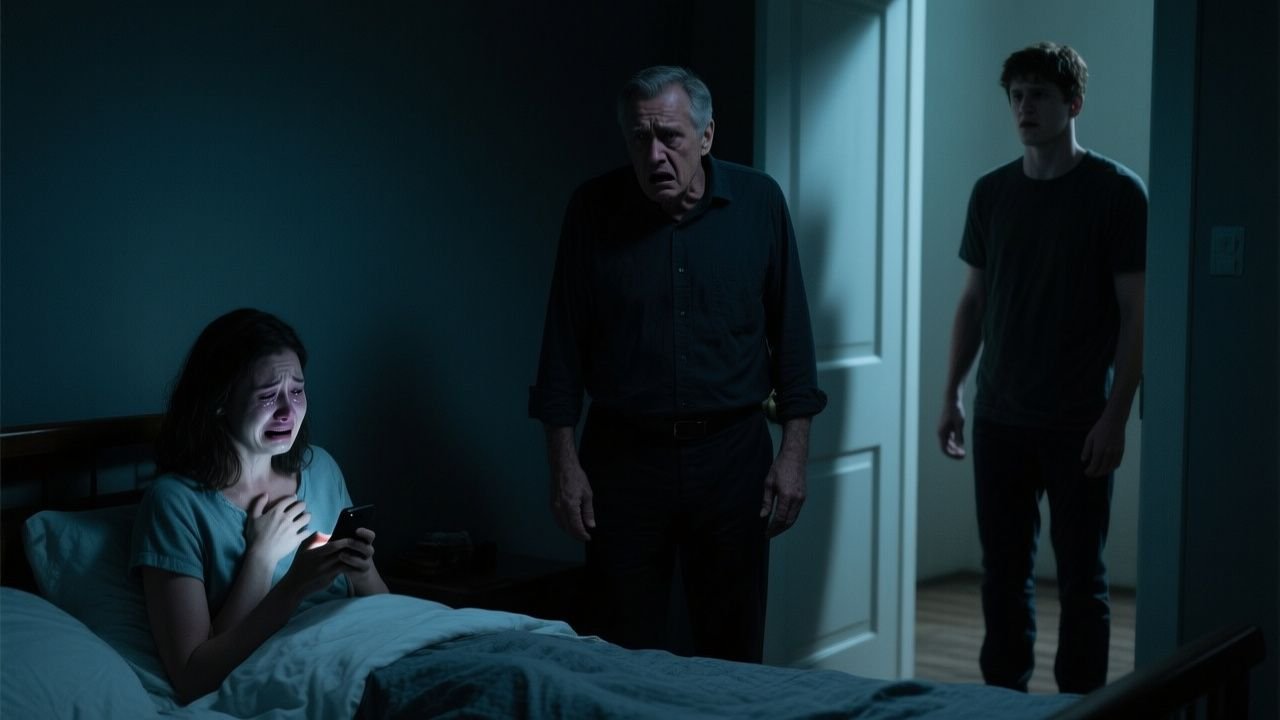
“She cries all day,” Clara said. “And at night. Sometimes I hear her through the wall. She has these dreams and she wakes up screaming.”
David felt his heart break further.
“And when she wakes up screaming,” Clara continued, “she comes to my room. She sits on my bed and tells me she’s sorry. She says she doesn’t know why she’s so sad.”
David knew what postpartum depression was.
He had read about it in the hospital waiting room while Jessica was in labor.
He had nodded along when the nurse gave them the brochure.
He had even checked it twice: first when Jessica was moody in the first weeks, and again when she was still moody at three months.
But he had always told himself it would pass.
He had always told himself she just needed more rest.
He had always turned his attention to work because work was a place where he could measure his progress.
Work was a place where he could see the results of his efforts.
Fatherhood was a place where his effort felt invisible.
And wifehood, apparently, had been a place where Jessica had been drowning without him noticing.
—
Clara was quiet again.
Then she spoke.
“One time I told her she needed more milk money,” Clara said. “And she didn’t answer me. Just stared at the wall for like ten minutes.”
“What did you do?”
“I made sure we had enough for the week,” Clara said. “I took my piggy bank and I counted the money and I put the extra in her purse.”
David didn’t know whether to laugh or cry.
“You used your birthday money?”
Clara nodded.
“I got 30 dollars from grandma,” she said. “I used 12 of it for milk.”
Six weeks ago, David remembered.
Clara had been so proud of her birthday money.
She had been planning to buy a set of art supplies.
Now she was silently taking care of her own mother.
“You have to stop,” David said quietly.
Clara looked at him sharply.
“Stop what?”
“Stop being the adult.”
Clara’s eyes glistened.
“If I stop, nobody will do it,” she said. “And mom will get even sadder. And Mikey will get even hungrier.”
“No,” David said firmly. “That’s not true. I’m here.”
Clara was quiet.
Then she said the words that broke him.
“You’re not here,” she whispered. “You’re at work. You’re always at work.”
—
The door to the bedroom opened.
David looked up.
Jessica stood in the hallway.
Her hair was disheveled.
Her face was puffy from crying.
She was wearing a hospital gown from the paramedic who had examined her, under a thin robe that she hadn’t changed out of in days.
The bruises on her arm had faded to a yellowish green.
The cuts on her hands had scabbed over.
But the invisible wounds were worse.
“Jessica,” David said.
She shook her head.
“I heard what she said,” Jessica whispered. “I heard all of it.”
Clara looked at her mother.
And for the first time, David saw something other than fear in his daughter’s eyes.
He saw anger.
“You always say you’re sorry,” Clara said. “But then nothing changes.”
“Clara—” David reached for her.
She pulled back.
“She says she’s sorry,” Clara repeated, pointing at Jessica. “And you say you’re sorry too. And then you pat my head and you go to work and she stays in bed and I have to take care of Mikey all over again.”
Kevin’s words hung in the air like an accusation.
The truth.
Clear and painful.
“I’m so sorry,” Jessica said.
“Stop,” David said harshly.
Jessica looked at him.
She opened her mouth to respond.
But for the first time in months, David had a carefully chosen phrase for what he needed to say.
“We’re saying things,” David said. “But we’re not doing things.”
He took a breath.
“And she is paying the price.”
Jessica closed her eyes.
The tears ran down her cheeks.
But she didn’t move.
—
“I don’t know why I can’t get out of bed,” she said quietly.
No excuses, no explanations.
Just the statement.
The moment leaked between them.
David walked toward her and stopped a few feet away.
His wife was a person he loved, but under-acknowledged thoroughly.
His wife was a person who was hurting.
And the person he loved was at her breaking point, sitting on the sofa of the home she’d been secretly holding up with the strength of her seven-year-old.
Seen now.
Pressed, and still barely breathing.
Now that he actually saw her, he wondered how he had missed it.
How he had missed all of it.
“I was scared,” Jessica said. “I was so scared, David.”
She wrapped her arms around herself.
“When I would finally feel enough strength to get out of bed,” she said, “I would get to the door and I would remember that I had to feed him or hold him or comfort him. And then all that energy would just drain out of me again. I would turn around and get back into bed.”
David looked at Clara.
His daughter was watching her mother with an expression he couldn’t read.
“One day I couldn’t even get to the door,” Jessica said. “And I heard Clara go into the kitchen. And she was pulling out the pans.”
She was silent for a moment.
“And I knew it was wrong,” she said. “But Clara went into that kitchen and started making something. And I didn’t stop her, David.”
Her grief burst out.
“I didn’t stop her. She was seven years old with stool together, and I didn’t stop her because it was the first time I had felt like I could rest.”
Sweat had broken out on David’s forehead.
“She learned to make toast the next week,” Jessica continued. “And then soup. And then she learned how to mix the formula.”
“No,” David whispered.
“She had to learn, David,” Jessica cried. “I couldn’t. I couldn’t bring myself to get out of bed and hold my son because every time I did, I felt like I was drowning in this… blackness. And I hated myself for it. And I hated that she had to do it all. But I also couldn’t stop.”
Clara began to cry.
“And so you just let her?” David demanded.
Then stopped when he saw the look on Clara’s face.
She wasn’t crying for hurting.
She was crying for relief.
Someone finally knew.
Someone finally saw.
—
The living room fell into silence.
No music.
No television.
No rain against the windows.
Just the occasional clink of Mikey in the crib next room, turning in his sleep.
Then Clara spoke.
“We have to help mommy.”
Jessica looked up.
“Clara…”
“We have to help mommy,” Clara repeated more firmly. “Because if we don’t, then mommy is going to be gone. One day, mommy will be gone.”
“That won’t happen,” David said.
“You don’t know,” his daughter said quietly.
David was stung by the insight in his seven-year-old’s words.
He knew what she was trying to say; the weight of her own pure innocence had been broken by months of silent burden.
At night she had been listening to her mother cry through the walls.
At night she had been lying quietly, listening for the sound of her mother getting up to make sure she hadn’t gone somewhere in the dark without her.
“Are you scared?” David asked softly.
Clara pressed her face into his chest and didn’t answer.
—
It was three in the morning when Jessica’s breathing finally evened out.
She was asleep in the bedroom now.
The hospital had given her a referral to a psychiatrist and a prescription for medication that David had already filled at the twenty-four-hour pharmacy.
Clara had fallen asleep on the couch.
She was curled up under the old blanket that had been hers when she was a baby.
The one with the zoo animals on it.
The one she had given to Mikey when he was born, but he didn’t use it—she had stolen it back.
David watched her.
Watched each breath rise and fall.
Watched a seven-year-old girl who looked smaller when she slept.
Smaller and younger and exactly the age she was supposed to be.
He quietly walked into the kitchen.
He stood at the sink and looked out over the city.
His phone sat on the counter beside him.
The same phone that had burned with her unanswered calls.
He picked it up and opened the contacts app.
He typed a new contact for “Clara Mae.”
He pressed the star button next to her name and added it to favorites.
Then he stood there and quietly sobbed.
—
The next morning, David called work.
“I’m taking six weeks of family medical leave,” he said.
He’d never requested time off during the two years after either of their kids was born.
He’d never left work for being sick or exhausted or depressed.
He was the type of man to take care of things.
To hand out solutions instead of needing them.
But now, at 10:34 in the morning on a Tuesday, standing in his kitchen with a coffee cup that had gone cold thirty minutes earlier, something in David had snapped.
“What?” his boss sputtered.
“I’m taking six weeks of family medical leave,” David repeated. “I have the paperwork in my e-mail. I’m telling you now so that it doesn’t affect any deadlines.”
There was silence.
Then his boss cleared his throat.
“Is everything all right?”
David looked through the kitchen doorway.
At the living room.
At his daughter curled up on the couch.
His daughter who had wrapped her pinky around Mikey’s chubby hand because she was too scared to sleep without knowing her brother was there.
At the hall where his wife lay in the dark and finally, finally receiving help he should have demanded weeks ago.
“Everything is going to be all right,” David said.
And for the first time in months, he believed it.
—
He didn’t go back to work that week.
Instead, he cleaned the apartment.
He washed the dishes.
He changed Mikey’s diaper.
He fed his son a bottle.
He put his daughter’s hair into a ponytail.
He cooked a real meal.
He stood behind Jessica when she managed to shower for the first time in four days and held her when she cried.
Then he took Clara’s hand and led her out to the car.
“Where are we going?” she asked.
“You’ll see,” he said.
She climbed into the car seat, and David buckled her in.
He hadn’t done this in so long.
Hadn’t done this in a while.
He used to be the one who put her in her seat.
The car seat had been installed wrong the whole time.
He’d been a hands-on dad in the early years, when Clara was tiny and simple.
Then the company had promoted him, and the hours got longer.
And he had slowly, silently, willingly traded his place on the playground for a place at the office.
Today, he fixed the buckle and gently pushed back a piece of hair from her face.
“Daddy?”
“Yeah?”
“Are you sad?”
“No,” he said honestly. “I’m not sad.”
“Then why are you crying?”
He laughed quietly and wiped at his eyes.
“Because I’m happy,” he said. “I’m happy that I get to be here with you today.”
Clara was quiet.
Then she said, “Will you pick me up from school?”
Her voice was hesitant.
As if she didn’t think she deserved to ask.
“Yes,” David said. “I will pick you up from school every day.”
“What about work?”
“Work will wait,” he said. “I’ll go back eventually. But I’m not going to miss this again. I’m not going to miss you again.”
Clara looked at her hands.
Her fingers were still wrapped in soft gauze.
They would heal.
But David knew the scars ran deeper.
He only hoped that time and presence would earn back the trust that he had so carelessly thrown away.
—
The park was mostly empty that morning.
A few mothers with toddlers.
An old man feeding pigeons.
David sat with Clara on the bench by the swings.
“Do you remember coming here when you were little?” David asked.
Clara nodded.
“You used to push me on the swing,” she said. “You would push me until I laughed so hard I couldn’t stop breathing.”
“I remember,” said David.
He studied her, the girl who was in the second grade, still young enough to play on a park swing at ten in the morning when she should have been at school.
But he had decided that the change didn’t have to happen overnight.
For now, this moment meant more.
Ever since the night before, when he had come home to his child, cooking soup for a baby, he had learned what mattered more than clocking in at the office.
“Clara?”
“Yes?”
“How did you learn to cook the soup?” asked David.
“Nonna taught me,” she answered.
David was stunned.
His mother? At his sister’s house?
“When she visited before Mikey was born,” Clara said. “It was the last time mom went to work. She taught me how to make pasta and soup as a special thing to show you when you came home.”
His mother had died a year ago.
He hadn’t had the chance to know the week before his death.
She had been gone, buried and mourned.
But Clara’s fingers were healing under his because she had inherited the strength of his Italian grandmother’s wrists.
Strength that he had never paid attention to.
Strength that his daughter had needed like air.
—
When Jessica came home from the hospital a few days later, she looked different.
Not fully healed—that would take time.
But different enough.
She had color in her cheeks that had been missing for months.
She had chosen to keep a grocery list that Clara had scribbled one day and thrown in the trash can.
She had made a list of her own.
Appointments.
Medications.
Meals.
Plans for being, just being, with her family.
David held her hand and looked in her eyes for longer than he had in months.
“How do you feel?”
“Better,” she said. “Not perfect. But better.”
“Good,” he said.
Then she looked past him at Clara.
Clara was playing with Mikey on the floor of the living room.
In a few years, she would go back to being a kid—a real kid.
But for now, David felt a peace settle in his heart as Clara giggled with her brother, not in fear or worry.
It had only taken a few days.
But the walk was still healing.
—
That night, as David was tucking Clara into bed, she looked up at him.
“Daddy?”
“Yeah?”
“If I call you at work tomorrow, will you answer?”
David sat on the edge of the mattress.
He took her hand.
“I changed my voicemail,” he said. “To a special one just for you.”
“Really?”
“Really. Listen.”
He activated his phone and played one of the voicemail greetings he set the day after.
“This is David,” his voice said. “I can’t come to the phone right now. But if you’re calling and you’re Clara, I want you to know that I will call you back as soon as I see your name. Matter of fact, I promise I will. And if it’s Mikey calling… well, Mikey can’t talk yet, so mommy will have to do that.”
Clara giggled.
Then she said, “What if it’s mommy?”
“Then I’ll answer too,” David said. “Because mommy is important too. And I might have to bring her a coffee and a hug on my lunch break.”
“Promise?”
“Promise.”
Clara’s eyes fluttered closed.
Within minutes, she was asleep.
David stood there for a long time.
Watching his daughter’s chest rise and fall.
Watching the bandages on her fingers, which were now just one sticky wrap.
She was seven years old.
She was seven years old, and she had almost lost everything that made her a child.
But she was still here.
They were all still here.
—
David walked into the kitchen and quietly shut the door.
He looked at the phone.
He scrolled through the call log.
Searching for the last list of missed calls from his home before Clara’s name took over.
There it was.
Twenty-three calls.
Twenty-three times his daughter had reached out for help and he had let her down.
Now the same number was three digits away from her name barely ringing, if she dialed him tonight.
His phone was silent.
So he dialed their home number.
It rang once.
Clara’s sleepy voice came on the line.
“Daddy?”
“Hey, sweetheart,” he said softly.
“Why are you calling? You’re in the kitchen?”
“I know,” he said. “I just wanted to hear your voice.”
She was quiet.
Then she said, “I love you, Daddy.”
He saw the small silhouette of his daughter through the bedroom doorway, lying on the bed with the phone pressed against her ear.
“I love you too, Clara.”
He paused.
Gathering the words he wished he had said eight weeks ago.
“And I’ll never miss your call again.”
The silence that followed wasn’t heavy.
It was light.
The light of a small hope beginning to heal.
—
In the days that followed, David became a different kind of man.
He arrived at the school gate fifteen minutes early.
He carried a spare change of clothes in his backpack everywhere in case Mikey got messy.
He sat beside Jessica at dinner and asked her questions he had never thought to ask before.
“What are you feeling right now?”
“What do you need today?”
“How can I help you tomorrow?”
He read about postpartum depression.
He learned about the kind of helplessness that had nothing to do with being strong.
He took his wife to her appointments.
He held her hand when she cried.
He told her, “You’re not weak. You’re a warrior. You fought this—you beat this. Let me help you now.”
He stopped telling Clara that her worries were “small.”
He started listening when she talked about her day.
He asked her about her homework and about her friends.
He watched, in real time, as she slowly shed the burden she had carried like a second skin.
The first time Clara asked if she could have a friend come over after school, David cried.
Not because it was a big request.
But because it meant she was finally, truly, becoming a child again.
—
Weeks passed.
Then the one conversation marked the turning point.
Jessica was sitting on the couch with Mikey asleep on her chest.
Her breathing was slow.
She wasn’t panicking.
Clara was sitting beside her, reading a picture book.
David was in the armchair across from them, pretending he had a reason to be in the room.
“Mom?”
Jessica looked down at Clara.
“Yes?”
“Are you okay?”
The question that carried so much weight.
Jessica thought about it before answering.
No noise.
No deflection.
She thought about all the days she had to lie to herself to make it through.
She thought about Clara asleep somewhere.
She looked at the daughter she had nearly destroyed without meaning to.
“I’m better,” Jessica said slowly. “Mommy’s getting better. And it’s okay to ask me that, Clara.”
“I don’t have to worry about it if you get worse?”
“We’re going to notice,” Jessica said. “We’re going to be there for each other. When I need help, I will tell you. When you need help, you will tell me. That’s how this works now.”
Clara thought about it.
She nodded.
“Okay,” she said. “Then can you push me on the swings?”
Jessica looked at David.
He raised an eyebrow.
“I think I can do that,” she said.
And she did.
—
The day Clara started second grade, David walked her to the school gates.
He held her hand in his.
She slipped it free at the door.
He watched her go.
Then she turned.
“Daddy?”
“Yeah?”
“Don’t forget,” she said firmly. “Pick me up at 3:15.”
He smiled.
“I won’t forget.”
She went inside.
He stood at the gate until the bell rang.
And that afternoon, at 3:15 exactly, he was waiting for her when she came out, beaming from ear to ear with a victory.
—
Months later, after the leaves had changed and fallen and the cold crept into the apartment, Clara’s school held its parent-teacher conferences.
Jessica went with David.
They sat across from Mrs. Harmon, Clara’s teacher.
“Clara is one of my best students,” the teacher said warmly. “She’s bright, compassionate, and eager to help her classmates.”
David felt a surge of pride.
“She’s also… very protective,” Mrs. Harmon continued. “She notices when other kids are sad. She’s the first one to comfort them.”
Jessica glanced at David.
“Is that a problem?” Jessica asked.
“Not at all,” Mrs. Harmon shook her head. “It’s wonderful. It just … I worry sometimes.” She paused thoughtfully. “I notice that whenever she gets a paper back or anything, she checks to make sure it’s not something she’s in trouble for. She’s cautious. Like she’s used to walking on eggshells.”
David gripped the armrest.
“She’s been through some changes at home,” he said, after a long silence.
Mrs. Harmon nodded.
“She’s still doing well, though,” she said. “And it’s a good sign that she’s relaxed enough to do that—to check, to protect, to care about them. It means deep down she knows she’s safe.”
Safe.
The word filled David with warmth and numbness all at once.
—
When they got home, Clara was playing with Mikey.
Mikey was almost walking now.
He stood wobbly, gripping Clara’s hands.
Clara’s fingers were all healed.
Just faint pink skin.
“He’s going to be a good little walker,” Clara announced.
David watched her.
Then he said, “That’s because he has a good big sister.”
Clara grinned.
She guided Mikey a few steps more before lifting him up.
She was eight years old, almost.
The girl who’d been forced to grow up years early was growing into herself for the first time.
—
One evening, Jessica stood in the kitchen—really stood—and looked out the window onto the city lights.
David came up behind her.
“Can I get you anything?”
She turned and smiled.
“No, I’m good.”
“Do you want to sit down?”
“David, I’m fine.”
He put his hands on her shoulders.
“I love you,” he said.
“I know. I love you too,” she replied.
Then she looked at him with a hint of skepticism.
“Are you going to help with bedtimes tonight?”
“Three thousand percent,” he said.
“Pretty confident math,” she said, grinning softly.
“I’ll help with bedtimes, I’ll do the nighttime feeding, and I’ll wake up with the baby tomorrow,” he said.
“That’s a good plan.”
He kissed her forehead.
Then he walked to the kids’ room.
Clara was in her bed reading.
Mikey was asleep in his crib.
“Hi, Dad,” Clara said.
“Hi, sweetheart.” He sat next to her on the bed.
“Can I read you a chapter?” she asked.
“I would like that.”
So she started reading.
He closed his eyes.
And as her voice filled the room—steady, sure, and not worried—he let himself fully feel his life for the first time.
A child who had been holding too much, and this child was okay.
She was safe.
They were all still there.
They had pulled each other off the edge before it was too late.
—
Later that night, long after Clara and Mikey had gone to sleep, David found himself in the kitchen.
He was scrolling through his phone.
Not calls.
Photos.
He stopped at a picture of Clara holding Mikey, taken at his first birthday party.
She was laughing.
In that year’s photo, she seemed the same—the same dark-haired girl.
Now, she had let go of the weight.
David looked up his company calendar.
He marked the dates he would take off over the next few months—all clear.
Then he logged onto the computer and typed an email to HR about flexible time schedules.
As he drifted off to sleep that night, he was at peace.
—
The story doesn’t end with the crisis that night.
The story doesn’t end with Clara’s burned hands or the twenty-three missed calls.
That’s not the end.
The true ending of this story is what comes after.
When a father realizes—really understands—that he has one chance to show his daughter she doesn’t belong buried in the heavy, unseen work of holding up a family alone.
When a mother learns to accept a hand extended without guilt.
And when a child gets to be exactly what she should have been all along.
Just a child.
The story ends when a girl of seven years old no longer has to check the house like a tiny adult before she says goodnight.
It ends when she turns eight and whispers into her father’s ear that she wants a puppy.
He gets her one.
That’s the story’s true ending.
—
But even now, years later, whenever Clara’s father looks at her for a moment too long, she asks, “What?”
He just answers, “Nothing. I love you.”
Then he’ll hold his phone—her contact still in favorites, screenshots taken of that old call log to remind him of what can be broken—and he’ll keep that reminder close to his chest.
He used to think that raising children was all about providing for them.
Then his seven-year-old taught him the difference between providing and being there.
And he would never forget it.
The girl who taught a whole family how to live again was still just that—a girl.
But her heart held more strength than most adults ever know.
And for as long as he lives, he’ll never miss another call.
Because the most important work he will ever do is not the same work that fills his bank account.
The most important work is the sound of his daughter’s voice on the other end of the line, saying, “Daddy, I’m just calling to say I love you.”
That is the call he answers every single time.

0 Comments