Llegaste a la parte final de la historia — the part where everything comes together, and the truth finally finds its voice.
The next weeks were a test of wills.
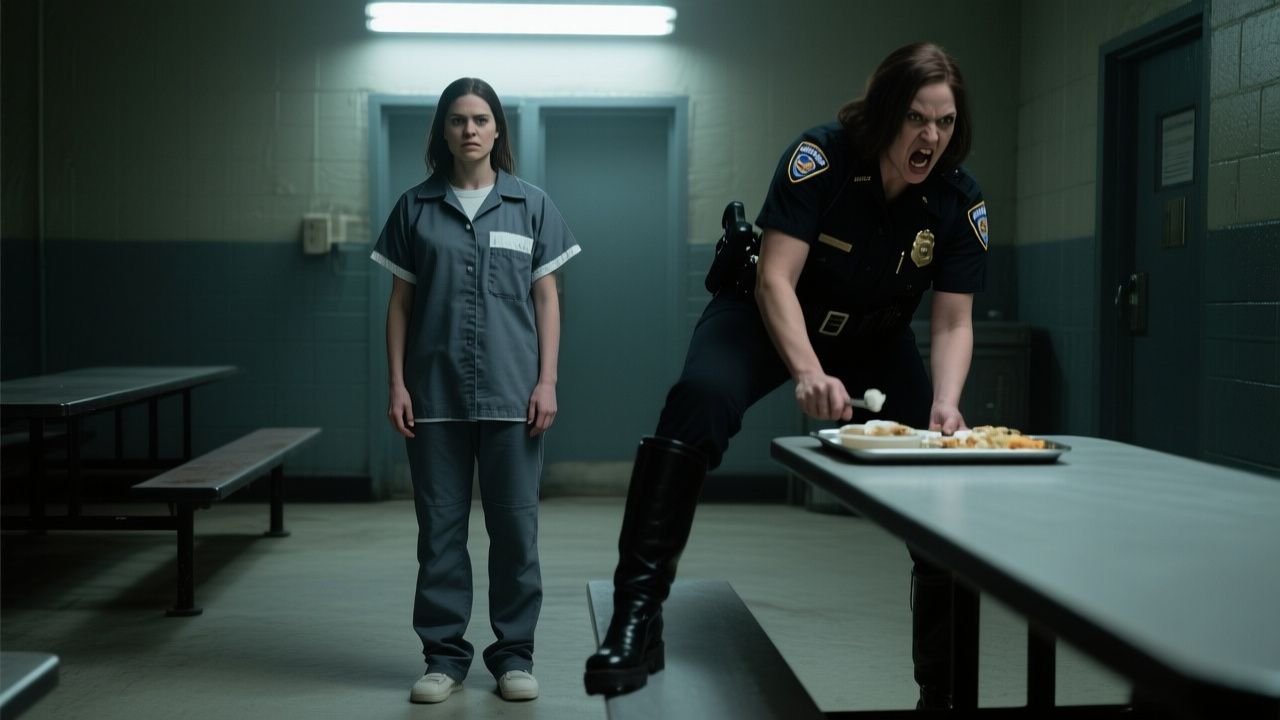
Rumors spread throughout Corazón Valley like wildfire. The story of the new guard who had humbled La Bronca grew with every retelling, gaining details that weren’t true and losing ones that were. Some said Renata had broken La Cuchilla’s arm with one hand while holding a cup of coffee in the other. Others said she had whispered something so dark in La Bronca’s ear that the queen had gone white as a ghost in the middle of the yard.
But what was true was more powerful than any legend.
La Bronca didn’t attack again.
Not because she was scared of Renata — though she was, more than she’d ever admit. But because something in that confrontation had shifted her worldview. She’d built her power on fear, on the belief that brutality was the only language that mattered in prison.
Yet here was a woman who had faced war, faced domestic abuse, faced the crushing weight of a life that should have broken her — and she still carried herself with a peace La Bronca had never known.
It gnawed at her. It kept her awake at night, staring at the ceiling of her cell, replaying the moment over and over in her mind.
“I have nothing left to lose.”
That was the key, wasn’t it?
—
The Unexpected Visit
It happened on a Sunday. Visiting day.
La Bronca sat in the commons area, watching families reunite through the glass partition. Children pressed their hands against the window, mothers pressed theirs back. Tears flowed like rivers. It was the only day when the prison felt almost human.
Renata was stationed at the far corner, observing everything with quiet eyes.
La Bronca had been watching her for weeks, ever since their confrontation. The way she treated other inmates with respect, even the ones who spat at her. The way she gave extra time to the pregnant ones, the way she looked at the young girls with something close to sadness.
She wasn’t like the other guards.
She wasn’t like anyone La Bronca had ever met.
On that Sunday, something moved inside La Bronca. Something that had been locked away for so long she forgot it existed.
She walked over to Renata.
The other inmates tensed, expecting round two. Even the guard standing nearby reached for her radio.
But La Bronca stopped a respectful distance away.
“I want to ask you something,” she said, her voice rough like it was dragging over sandpaper.
Renata looked at her. Not with fear. Not with triumph. Just waiting.
“When your husband hit you that first time,” La Bronca asked, “why did you stay?”
Renata’s face remained neutral, but something flickered deep in her eyes.
“Everyone asks why women stay,” she said quietly. “No one asks why the men felt safe enough to hit.”
La Bronca blinked.
“I stayed because I was taught that love meant patience,” Renata continued. “That if I was better, quieter, more understanding — he would stop. It took me five years to learn that no amount of my love could fix his sickness.”
“And when you finally left?” La Bronca pressed.
“I didn’t leave,” Renata said. “I retaliated. I defended myself so thoroughly that he never dared touch a woman again. The courts called it justified.” She paused. “That was the day I stopped being a victim. The day I realized that the only power anyone has over you is the power you give them.”
La Bronca stared at her for a long moment.
“I took my first beating when I was thirteen,” she said suddenly. The words came out hard, unbidden, like water breaking through a dam. “From a stepfather who had no right to even look at me. I ran away at fifteen. Got picked up by a crew, learned to fight, learned that the only way to keep from being hurt was to hurt first. Every time I raise my fists, it’s not me doing it. It’s that little girl screaming inside.”
The yard had gone quiet. The other inmates pretended not to listen, but they listened.
“You chose to stop the cycle,” Renata said softly. “Or you can keep feeding it. The only person keeping you locked up in here is you.”
—
The Crown Rebuilt
La Bronca didn’t answer.
She turned and walked away.
But that night, in her cell, she did something she hadn’t done in years. She sat on her bunk and looked at her own hands. The hands that had broken noses, held weapons, signed people’s death warrants.
And for the first time, she didn’t see a weapon.
She saw hands that could have held a child. That could have signed a peace treaty. That could have written a different story.
It took a month, but it started small.
Word spread that La Bronca had stepped in when one of the younger inmates was being pressured by the other gangs inside. That she had protected a frightened girl from the violence — not with force, but with words.
No one understood it at first. They thought it was a power move. A manipulation.
But Renata noticed.
She saw the way La Bronca started sitting with the ones who were alone, the way she made sure the newest arrivals — the ones most likely to be consumed by the system — had someone they could trust.
It wasn’t a redemption story. Not in the clean, cinematic way.
There was no dramatic speech, no choir of angels, no forgiveness from the people she’d hurt. La Bronca still carried her sins like a chain around her neck. But for the first time in her life, she chose not to add more links to it.
And that was enough.
—
Three Years Later
Renata Molina sat in the visitation room, watching the door. She wasn’t a guard anymore — she had moved up the ranks, become the warden’s right-hand, a position she had earned through the quiet, relentless dignity she’d shown on the hardest days.
When La Bronca walked in — wearing handcuffs, but standing tall — Renata stood up to greet her.
“I got the transfer request,” Renata said. “You’re leaving.”
“I’m not leaving,” La Bronca corrected. “I’m going somewhere else. There’s a program, out in the countryside, working with kids who are on the same path I was on. Teaching them street skills.” She smiled, a strange expression on those ink-stained features. “Teaching them there’s a way out that doesn’t involve hurting people.”
“Why?” Renata asked, genuinely curious.
La Bronca was quiet for a moment.
“You once told me that the only power anyone has over you is the power you give them,” she said finally. “I spent my whole life scared that if I let go of my power, someone would take everything from me. But you never let go of yours — even when you had nothing. And that taught me that authority isn’t about being feared. It’s about being the thing someone else can look at and think, ‘if she can, maybe I can too.’”
Renata felt her chest tighten.
“You became that thing for me,” La Bronca said, and her voice cracked for the first time. “I don’t know if I can undo what I did. I don’t know if I’ll ever be free of it. But I know I want to try. And that’s more than I’ve ever wanted before.”
They stood there — the guard who had faced her demons and the queen who had finally surrendered — looking at each other not as enemies, but as survivors.
“When I came here,” Renata said quietly, “I thought I was coming to a place where people only hurt each other. And I was right. But I was also wrong. Because this place gave me the chance to see someone choose a different path.”
La Bronca took a deep breath.
“Do you think there’s hope for people like me?” she asked.
Renata smiled — the first true smile she’d shown in this place.
“There’s hope for everyone who decides they don’t want to be the person they were yesterday,” she said. “And you just became someone else.”
As La Bronca walked out of the prison gate that day, heading toward a road she was choosing for the first time, she paused to look back at the walls that had defined her for so long.
Then she turned forward and kept walking.
Because in the end, the strongest prison walls aren’t made of concrete and steel.
They’re built inside the places no one else can see.
And broken only when you decide you want out.

0 Comments