If you found your way here from Facebook, then you already know something happened in that house that nobody was ready for. What you don’t know yet is everything that led up to it — and everything that came after.
Settle in. This one’s worth reading all the way through.
—
Her name was Rosa.
Not “the housekeeper.” Not “the help.” Not the invisible woman in the white uniform who moved through the marble hallways of the Villanueva estate like a ghost no one bothered to acknowledge.
Her name was Rosa Medina, and she had been cleaning that house for eleven years.
Eleven years of arriving before sunrise so the floors would be gleaming by the time the family woke up. Eleven years of washing dishes that cost more than her monthly rent, folding sheets with a thread count she would never sleep on, and polishing silverware that would only be used twice a year when the Villanuevas hosted their dinner parties for people who also had silverware they never used.
She knew every corner of that house better than the people who lived in it.
She knew which floorboards creaked near the east hallway. She knew that the second bathroom on the third floor had a faucet that dripped at exactly 2 a.m. if you didn’t shut it off with two full turns to the right. She knew that the boy — the Villanueva’s seventeen-year-old son, Mateo — had a habit of leaving his energy drink cans under the couch cushions and pretending he had no idea how they got there.
She had cleaned up after Mateo since he was six years old.
She had watched him grow from a chubby little boy who used to steal cookies from the kitchen and blame the dog, into something else entirely. Something that made her stomach tighten when she heard his footsteps coming down the hall.
Mateo Villanueva had grown into the kind of teenager who had never once been told no and had absolutely no idea what to do with people who didn’t immediately bend to accommodate him.
He was tall now. Broad-shouldered. He wore designer sneakers that Rosa had seen advertised online for four hundred dollars, and he wore them with the careless ease of someone who had never had to think about whether he could afford something.
He had his father’s jaw and his mother’s eyes, and he had learned, somewhere along the way, that the world was divided into two kinds of people: the ones who mattered, and the ones who served.
Rosa, in his mind, belonged to the second category.
She had felt it for years — the way he would walk past her without acknowledgment, the way he would drop things deliberately just to watch her pick them up, the way he talked on his phone at full volume while she vacuumed around his feet, as though she were a piece of furniture that happened to move.
But she had never expected what happened on a Thursday afternoon in March.
—
The Afternoon Everything Broke Open
The living room of the Villanueva estate was the kind of space designed to impress visitors more than to actually be lived in.
The ceiling stretched up two full stories, with a chandelier that Rosa had to climb a special ladder to dust every other month. The furniture was cream-colored — impractical, expensive, impossible to keep clean — and the floor was a pale travertine marble that showed every footprint and scuff.
Rosa was on her hands and knees that afternoon, working a particularly stubborn stain near the base of the entertainment console. She had her earbuds in one ear — an old habit, a small private world she allowed herself when the family wasn’t home — and she was almost done with the room.
Almost.
She heard him before she saw him.
She pulled out her earbud and turned, expecting him to walk past the way he usually did.
He didn’t walk past.
He stopped.
He looked down at her the way you might look at a spot on the floor — not with contempt, exactly, but with the particular indifference of someone who doesn’t see a person at all.
“You missed a spot,” he said.
Rosa looked at the area he was gesturing toward. She hadn’t missed it. She hadn’t gotten to it yet.
“I’m working my way over there,” she said. Calm. Even.
Mateo made a sound in the back of his throat — something between a laugh and a dismissal — and turned toward the couch.
What happened in the next thirty seconds, Rosa would replay in her mind for weeks afterward.
She had moved to stand, shifting her weight to reach further along the baseboard, and her cleaning cloth had caught the edge of the small side table near the armchair. Not hard. Barely a brush. But it was enough to knock Mateo’s phone off the armrest where he’d set it, and the phone clattered to the floor.
The screen didn’t crack. She could see that immediately.
But Mateo spun around as if she had thrown the thing at him.
“What the —” He crossed the room in three steps.
“I’m sorry,” Rosa said quickly, already reaching for the phone. “It was an accident, it’s not —”
She didn’t finish the sentence.
Because that’s when Mateo’s hand came down.
It wasn’t a punch. It was a slap — an open-handed, contemptuous swat, the kind you’d give something you wanted to knock away. His hand connected with her forearm as she reached for the phone, knocking her hand aside and sending the cleaning cloth flying.
The sound it made was small. Barely anything.
But the room went very, very still.
Rosa straightened up slowly.
Her arm stung. She would find a faint red mark there an hour later, already fading, but present.
Mateo barely seemed to register what he’d done. He picked up his phone, checked the screen, tucked it in his pocket.
“Watch what you’re doing,” he said. Like that was the end of it.
Rosa stood there, her chest rising and falling, and she thought about eleven years. She thought about the paycheck that went to her daughter’s school supplies. She thought about the rent. She thought about the way his mother, Mrs. Villanueva, always said she was “like family” at Christmas when she handed over the bonus envelope.
She thought about all the reasons she had always, always stayed quiet.
And she was still thinking about them, still standing there in that impossible silence, when the front door opened.
—
She Came Through That Door Like a Storm
Valeria Medina was nineteen years old, and she had her mother’s eyes and her grandmother’s temper, and she had stopped by after her morning classes because she’d forgotten her charger at her mom’s place the day before.
She almost didn’t come in. She had texted her mom first — just grabbing the charger, I’ll be quick — and she still had her backpack on her shoulder when she pushed through the side entrance that the staff used, the one that let out near the kitchen.
She heard it before she understood it. That particular quality of silence. The held-breath stillness of a room where something wrong had just happened.
She walked through the kitchen doorway and into the living room, and she took in the scene in pieces.
Her mother, standing very straight, her hands at her sides, her face carefully composed into the expression Valeria had seen her whole life — the one her mother wore when she was holding something very difficult very quietly.
The boy. Standing with his phone in his hand, barely looking at her mother.
And then she saw the red on her mother’s forearm. That faint, unmistakable flush.
“Mamá.” Her voice was low. “What happened?”
Rosa shook her head almost imperceptibly. The smallest possible movement. Not now. Not here. Let it go.
Valeria had spent nineteen years learning to read her mother’s face, and she had spent nineteen years watching her mother tell her to let things go.
She set her backpack down on the floor.
“What happened to your arm?” she asked again, and this time she wasn’t asking her mother. She was looking directly at Mateo.
He turned toward her with the expression of someone mildly surprised to find a cat has wandered into the room.
“Who are you?” he asked.
“Her daughter,” Valeria said. “What did you do to her arm?”
Mateo looked at Valeria with slow, deliberate amusement. He took in her worn sneakers, her backpack from a mid-range brand, her jeans that had a small fraying at the left knee. He took in all of it, catalogued it, and apparently arrived at a conclusion.
“Relax,” he said, with a smile that didn’t reach his eyes. “Your mom knocked my phone. I barely touched her. That’s how this works — you break something, there are consequences.”
“Consequences,” Valeria repeated.
“Look, I don’t know what she told you, but —”
“She didn’t tell me anything.” Valeria took a step forward. “I can see it on her arm.”
Mateo laughed. It was a short, sharp sound, designed to be dismissive. “Okay. So what? What are you going to do about it?”
He was smiling when he said it. Genuinely, authentically amused. As though the question were rhetorical. As though the answer were obviously nothing, because what could she possibly do?
He was bigger than her. He was wealthier. He was in his house, and she was the housekeeper’s daughter who had wandered in through the service entrance.
He looked at her the way he had looked at her mother for years.
And Valeria held his gaze without blinking.
“I’m going to give you one chance to apologize to her,” she said. “Right now. To her face.”
Mateo tilted his head. His smile widened. “Are you serious right now?”
“One chance.”
He laughed again, louder this time. He looked around the room as though there were an audience he could share this moment with.
“I’m not apologizing to the housekeeper,” he said. “That’s not —”
He took a step toward Valeria. Not aggressive exactly — something worse than that. Condescending. The way you step toward something small to demonstrate that you’re not afraid of it.
“You need to leave,” he said. “Both of you. I’ll tell my mom Rosa got aggressive, and we’ll see how long she keeps her job after —”
He didn’t finish the sentence.
Because that’s when Valeria moved.
—
The Part Nobody Expected — Least of All Him
It wasn’t wild or frantic. It wasn’t a scream or a shove or the kind of desperate flailing that people expect when someone who’s been backed into a corner finally breaks.
It was precise.
Valeria had taken kickboxing classes since she was fourteen — not for sport, not for competition, just because her mother had saved up to enroll her and told her that she wanted her daughter to know, deep in her bones, that she was never helpless.
Three years of training. Once a week at the community gym six blocks from their apartment. Never flashy, never bragging about it, just present in the way she held her shoulders and the way her feet moved when she walked.
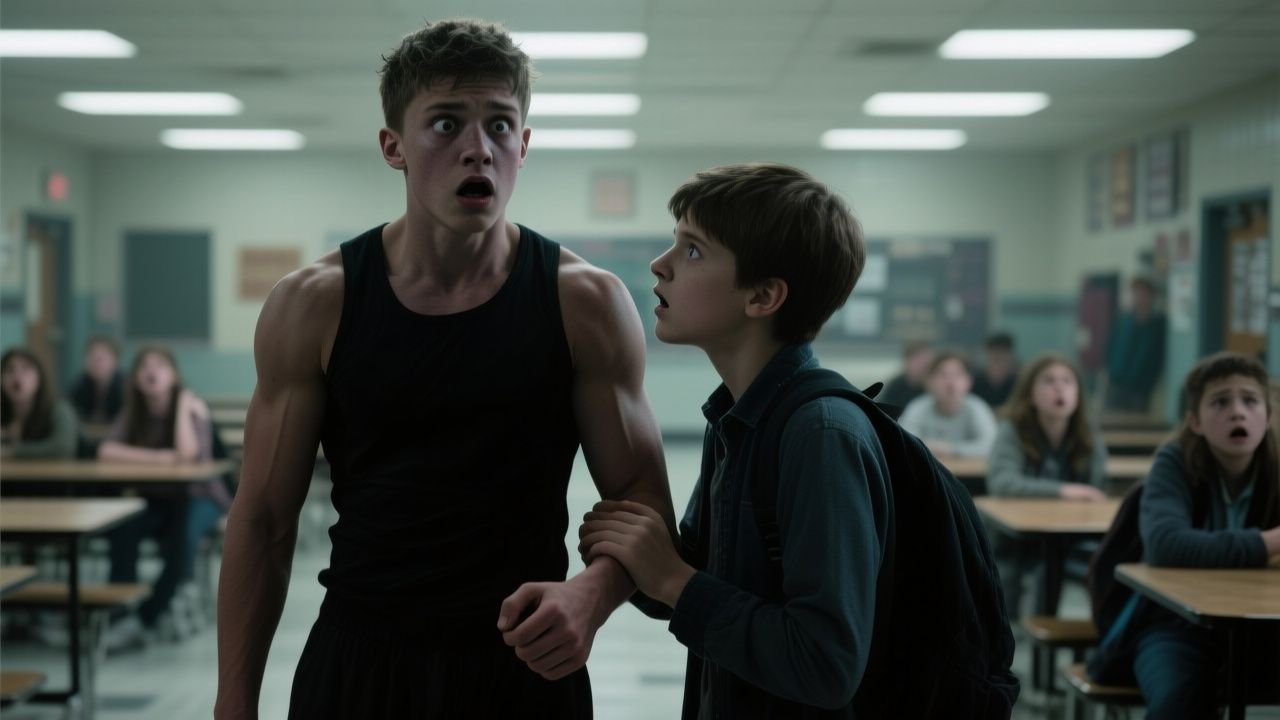
She planted her left foot, shifted her weight, and drove a clean, controlled side kick directly into Mateo Villanueva’s chest.
Not his face. Not his ribs with intent to injure.
His chest. The flat, open center of him.
It was enough.
He went backward. His feet left the ground for one absurd, suspended moment. And then he sat down hard on the pale travertine floor, his phone skidding out of his pocket again, his expression completely stripped of the smirk for the first time.
He wasn’t hurt. He was winded. Startled in a way that went so much deeper than physical surprise — startled in the way that only happens when the world behaves in a way you never once considered possible.
He sat there on that expensive marble floor and he looked up at Valeria Medina, and for the first time in that room, possibly for the first time in years, he had absolutely nothing to say.
Rosa had gone very still beside her daughter.
Valeria straightened up. She didn’t yell. She didn’t cry. She didn’t do any of the things that a girl in her position might be expected to do.
She stood over him and looked down, and her voice, when she spoke, was quieter than it had been the entire time.
“Apologize to my mother,” she said. “Now.”
The room held its breath.
Mateo looked from Valeria’s face to Rosa’s face and back again.
He was seventeen years old, and no one had ever put him on the floor before. No one had ever looked at him the way this girl was looking at him — not with rage, not with fear, not with any of the emotions he knew how to use or deflect.
She looked at him like he was simply a problem she had already solved.
“I’m sorry,” he said finally. His voice came out smaller than he intended. He said it to the floor, and then, because Valeria didn’t move, he made himself look at Rosa and say it again. “I’m sorry.”
Rosa nodded once. Slowly. With the dignity of a woman who had been waiting eleven years for something to feel like that.
Valeria held Mateo’s gaze for three more seconds. Just long enough for him to understand that this was not a performance, not a tantrum, not something he could report to his mother and spin into a story where he came out ahead.
Then she picked up her backpack from the floor, walked to her mother, and took her gently by the hand.
“You don’t have to come back here,” Valeria said quietly.
“I know,” Rosa said.
They walked out through the same door Valeria had come in.
Behind them, Mateo Villanueva was still sitting on the floor of his family’s living room, in a house with marble floors and a chandelier that took a special ladder to dust, surrounded by all the expensive, beautiful, entirely useless things that had never once taught him anything about what actually makes a person worth something.
—
The drive home was quiet.
Valeria kept one hand on the wheel and glanced over at her mother twice. Rosa sat with her hands folded in her lap, looking out the window at the street, and the look on her face wasn’t sad, exactly.
It was something more complicated than sad. Something that looked a little like relief, and a little like grief, and a little like the particular freedom that comes from finally putting down something heavy you’ve been carrying for so long you forgot it wasn’t supposed to be yours.
“Are you okay?” Valeria asked.
“I will be,” Rosa said.
And then, after a long moment, Rosa looked over at her daughter — this nineteen-year-old girl with the fraying jeans and the worn backpack and the absolute, unshakeable certainty that her mother’s dignity was worth more than any job, any paycheck, any marble floor — and she said something she had maybe never said clearly enough before.
“Thank you for coming through that door.”
Valeria kept her eyes on the road.
“I will always come through that door,” she said. “Every time.”
Some lessons take decades to learn, and some people spend entire lifetimes waiting for someone to tell them their dignity was never for sale in the first place. The truth that Rosa and Valeria carried out of that house that day was never complicated — it was just that nobody had said it out loud in that room before. And sometimes, all it takes is one person willing to say it clearly, to stand in the middle of someone else’s expensive silence and refuse to disappear, to change the air in a room forever.
That person doesn’t have to be powerful. They don’t have to be wealthy or connected or hold any of the cards.
They just have to love someone enough to walk through the door.

0 Comments